
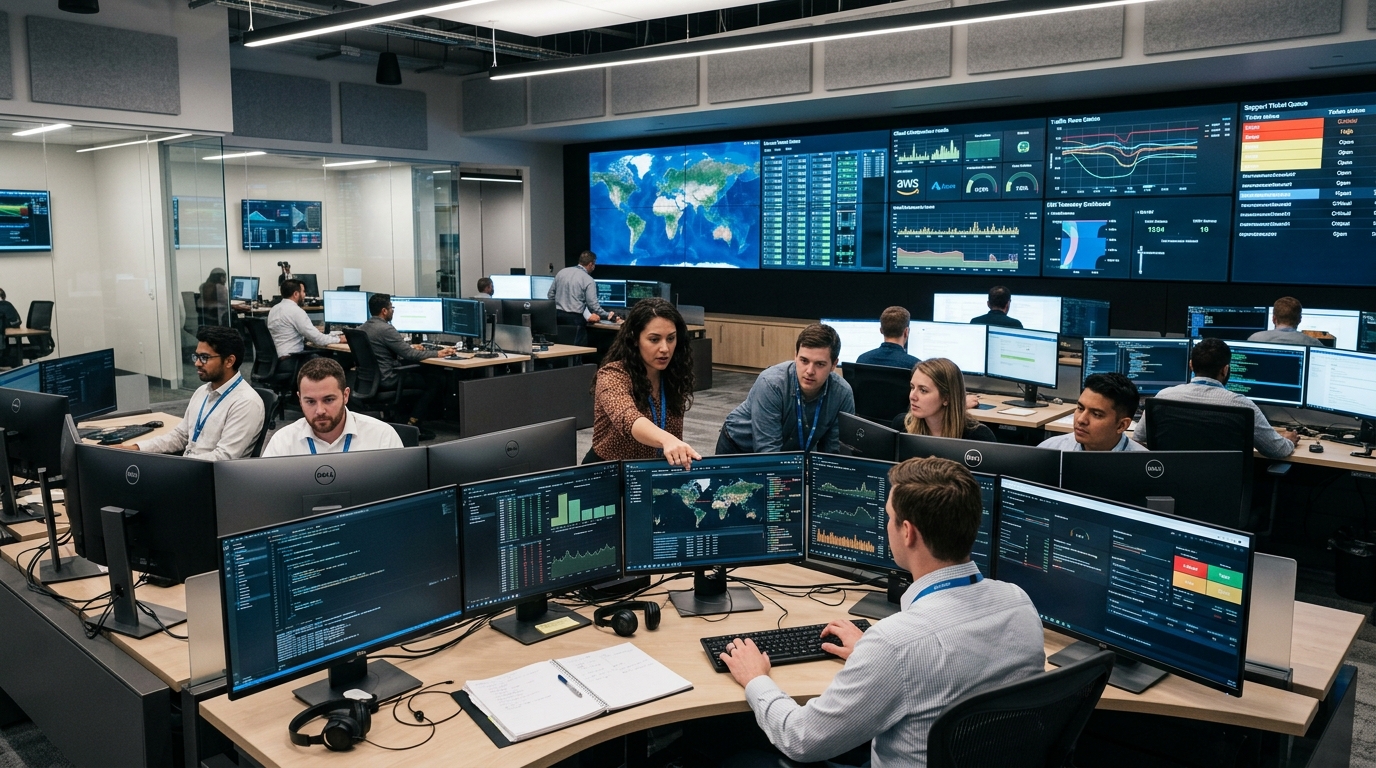
Why Traditional "Break-Fix" ERP Support Fails US Enterprises
For most mid-market and enterprise organizations in North America, ERP downtime is measured in thousands of dollars per minute. When warehouse pick-pack queues stall, EDI purchase orders fail to post, or month-end financial consolidations freeze on the last day of the fiscal quarter, submitting a ticket to an offshore helpdesk that responds 18 hours later is unacceptable.
Dedicated Dynamics 365 Business Central support services in the USA replace reactionary ticket queues with proactive Application Performance Monitoring (APM), dedicated onshore technical account leads, and guaranteed 15-minute response SLAs for critical revenue-impacting events.
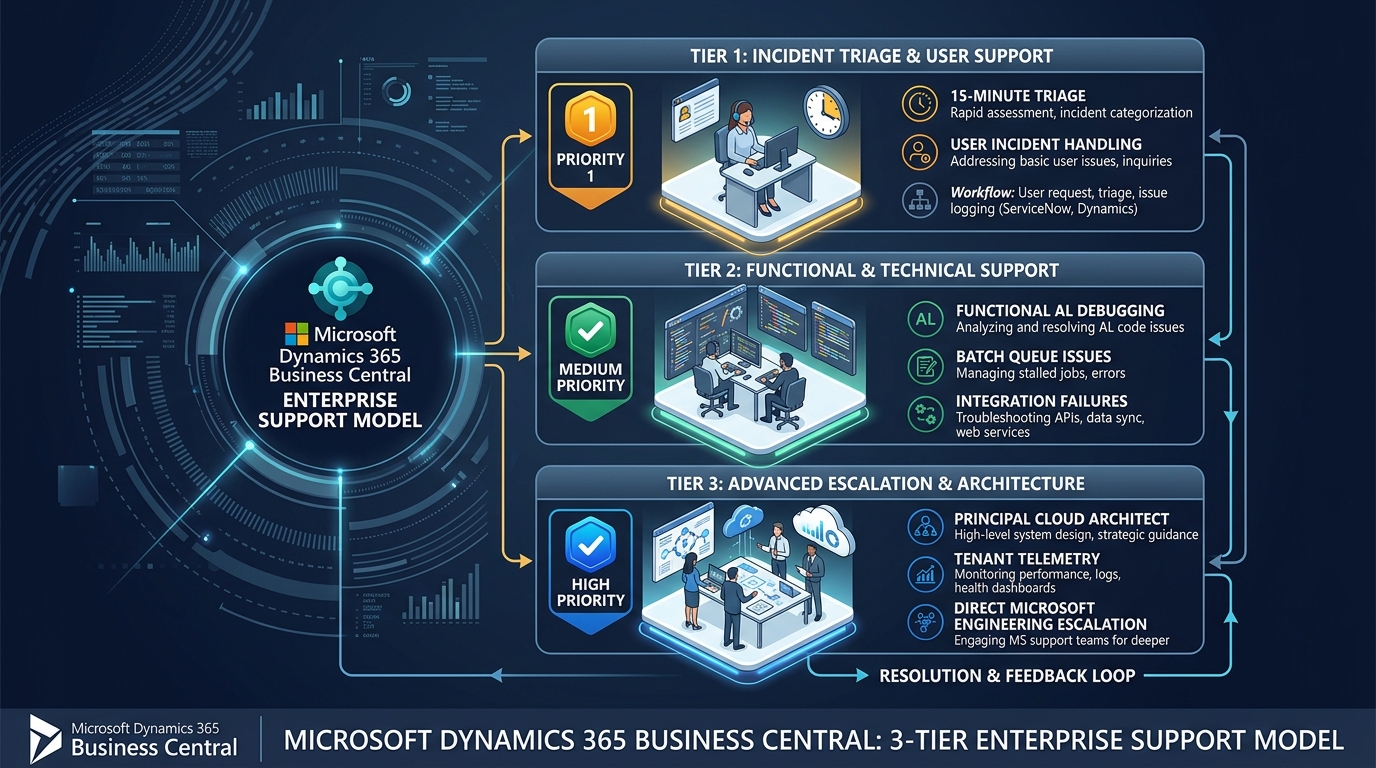
1. The 3-Tier Enterprise Support Architecture: Tier-1 to Tier-3 Demystified
A high-reliability Business Central support model is categorized into three distinct operational tiers, ensuring that simple user credential resets do not divert senior cloud engineers, while deep database deadlocks receive immediate attention from certified architects.
Tier 1: Frontline Operations & User Enablement
Immediate triage, permission set adjustments, personalized user guidance, posting date verification, and basic batch job restarting. Focuses on resolving user friction within minutes without modifying production code.
Tier 2: Functional Specialists & AL Debugging
Senior functional consultants and AL developers investigating complex transaction errors, inventory reconciliation mismatches, custom extension bugs, and failed Shopify/EDI data exchanges.
Tier 3: Principal Cloud Architect & Core Escalation
Telemetry log analysis in Azure Application Insights, SQL table lock mitigation, sandbox regression analysis for Major Release Waves, and direct Premier support escalation with Microsoft engineering teams.
2. Guaranteed Service Level Agreements (SLAs) for Revenue-Critical Operations
Enterprise support agreements must be underpinned by strict, measurable Service Level Agreements (SLAs). Contractual response times are categorized by operational severity:
| Severity Level | Operational Impact Criteria | First Response SLA | Root-Cause Target |
|---|---|---|---|
| P1 • Critical | Complete ERP tenant outage, warehouse shipping halt, point-of-sale failure, financial ledger posting locked. | ≤ 15 Minutes | Continuous until stabilized (≤ 2 Hours) |
| P2 • High | Major department impaired; workarounds exist but manual effort is substantial (e.g., EDI batch queue stalled). | ≤ 1 Hour | Same business day (≤ 6 Hours) |
| P3 • Medium | Isolated functional issue affecting specific users without halting core shipments or invoicing. | ≤ 4 Hours | Within 2 business days |
| P4 • Low | General system inquiry, report layout request, training clarification, or future release configuration. | ≤ 8 Hours | Scheduled release sprint |
3. Month-End & Year-End Close Protection Protocol
The final 72 hours of any fiscal month or quarter represent the highest stress period for finance teams. Stalled inventory cost adjustments, foreign currency revaluation errors, or out-of-balance general ledger entries can delay critical executive board reports.
Our US Business Central managed support framework includes a dedicated Month-End Close Protection SRE Protocol:
- Proactive Job Queue Auditing: Pre-clearing stuck background sessions and optimizing batch queue concurrency 48 hours prior to month-end close.
- Extended Support Standby: Dedicated US-based finance consultants available through late evening close hours on the final business days of each month.
- Inventory Valuation Reconciliation: Automated pre-checks verifying that Adjust Cost - Item Entries has completed cleanly without unposted transaction gaps.
- Code & Deployment Freeze: Imposing strict change freezes on custom AL extensions and integration webhooks during the active close window.
4. Telemetry-First Support: Azure Application Insights & SQL Table Lock Prevention
Modern cloud ERP support is not waiting for users to complain about a spinner. It is detecting and resolving bottlenecks before users even notice latency.
By connecting Business Central environment telemetry directly to Azure Application Insights, our support engineers monitor:
- Long-Running SQL Queries: Queries executing over 5 seconds automatically trigger an alert with call stacks identifying the exact AL code extension and table key involved.
- Table Lock Contention: Real-time monitoring of exclusive table locks on high-traffic tables like Sales Header, Item Journal Line, and G/L Entry.
- Web Service & API Failures: Instant alerts on 429 rate-limiting spikes or 504 timeouts from external eCommerce or CRM connectors.
- Automated Job Queue Health: Automated pings if critical scheduled background jobs fail or stall in an in-process state.
5. When to Switch Business Central Support Partners
A substantial percentage of our enterprise clients came to Allgrow after experiencing frustration with their original implementation partner. Typical warning signs that your organization has outgrown its current support provider include:
- Tickets languishing for days with generic "we are looking into it" responses while core operations remain halted.
- Support representatives lacking deep AL code knowledge, unable to troubleshoot custom extensions without billing you astronomical diagnostic fees.
- No onshore presence during your critical morning shipping windows (7:00 AM - 11:00 AM EST).
- Fear of biannual Major Release Waves because prior updates repeatedly broke customizations.
Transitioning to a new CSP (Cloud Solution Provider) partner of record requires zero downtime and zero interruption to your existing Microsoft tenant licensing. Review our comprehensive Business Central Partner Takeover Playbook for the exact step-by-step transition checklist.