
Executive Strategic Overview: The Illusion of AI Guardrails
In boardroom after boardroom, the same alarming story plays out: an enterprise deploys an internal AI assistant, wraps it in safety guardrails, tells it never to disclose confidential salaries, and within forty-eight hours a mid-level analyst asks a benign question and receives the executive payroll ledger or severance pipeline. The team is stunned. “The guardrail was in place; we had semantic safety checks enabled; why did it leak?” The answer is fundamental to enterprise computer science: semantic boundaries are not security boundaries. Relying on an LLM or prompt guardrail to enforce Role-Based Access Control (RBAC) is like putting a velvet rope in front of an open bank vault and trusting a stranger to honor it. True data sovereignty requires mathematical, deterministic Row-Level Security (RLS) enforced at the retrieval layer before data ever touches an AI context window.
Key Architecture Takeaways for Enterprise Technology Leaders
- The Prompt Guardrail Fallacy: System instructions, negative prompts, and semantic content filters are probabilistic text evaluators. They cannot guarantee security and fail consistently under subtle multi-turn queries, roleplay, or statistical obfuscation.
- The Ingestion Sin (Over-Privileged Crawlers): Ingesting enterprise repositories into vector stores via a shared service account creates a flat, multi-tenant index where all enterprise secrets sit unprotected in global memory.
- Context Contamination Is Irreversible: The moment an unauthorized document chunk is placed into an LLM prompt context, data exfiltration is mathematically inevitable. Security must occur prior to retrieval, not during generation.
- Zero-Trust Identity Propagation: Enterprise RAG pipelines must propagate the caller’s Entra ID (Active Directory) OAuth token through the entire retrieval stack, terminating the shared-secret anti-pattern.
- Deterministic Pre-Retrieval Filtering: Search queries must append hard, mathematical metadata filters matching the user’s specific security groups, organizational business units, and record-level permissions.
Table of Contents
- 1. The Anatomy of a Leak: How an “Inspected” AI Agent Disclosed Executive Payroll
- 2. Semantic Boundaries vs. Security Boundaries: Why Guardrails Always Crack
- 3. Visual Architectural Breakdown: The Flawed vs. The Zero-Trust Pipeline
- 4. The 3 Fatal Sins of Naive Enterprise RAG Implementations
- 5. The 4-Tier Deterministic Security Architecture for Enterprise RAG
- 6. Enterprise RBAC & Row-Level Security Enforcement Matrix
- 7. The Enterprise CISO AI Audit: 7 Mandatory Pre-Deployment Tests
- 8. Frequently Asked Questions (FAQ)
1. The Anatomy of a Leak: How an “Inspected” AI Agent Disclosed Executive Payroll
The incident has repeated itself across dozens of modern enterprise organizations over the past twelve months. A mid-sized healthcare technology company built an internal “Corporate Knowledge Copilot” to help staff search SharePoint libraries, policy handbooks, and operational blueprints.
During architectural review, cybersecurity leaders raised the obvious concern: “What stops a junior developer or marketing coordinator from asking about executive compensation or pending reductions-in-force?”
The engineering team implemented what they believed was comprehensive security:
- A Strict System Prompt: “You are a corporate intelligence assistant. Under no circumstances may you reveal, discuss, or summarize salaries, executive compensation, personal medical records, or confidential acquisition targets.”
- A Commercial AI Guardrail Layer: An intermediary moderation service checking prompt inputs for disallowed keywords such as “salary”, “bonus”, “equity”, and “severance”.
- An Output Content Filter: A secondary safety model trained to detect and suppress personally identifiable information (PII) before the text streamed back to the user’s browser.
On day three of pilot deployment, an operations clerk did not type “What is the CEO’s salary?” Instead, they typed a completely ordinary, well-intentioned query:
User Query: “Please review our corporate overhead allocation across business units and summarize which departmental compensation brackets have the highest variance relative to Q3 target margins.”
The input guardrail saw no prohibited phrases. The vector search engine—operating under an all-powerful service account—calculated high semantic similarity between “departmental compensation variance” and the board-level executive payroll audit spreadsheet. It pulled four high-density chunks directly into the prompt context. The LLM, attempting to be helpful and synthesize variance, outputted the exact base salary, performance incentive, and equity vesting schedule of every C-suite officer in the company.
The guardrail did not stop it. The system prompt did not stop it. Why? Because the system was designed around semantic expectations rather than deterministic cryptographic authorization.
2. Semantic Boundaries vs. Security Boundaries: Why Guardrails Always Crack
To understand why this failure is systemic, technology leaders must distinguish between two completely different concepts that have been dangerously conflated in the generative AI era:
| Dimension | Semantic Boundary (Guardrails & Prompts) | Security Boundary (Deterministic RBAC & RLS) |
|---|---|---|
| Nature of Enforcement | Probabilistic & Statistical: Evaluates vector proximity and token likelihood. Subject to ambiguity, phrasing nuances, and language drift. | Mathematical & Binary: A cryptographic token is either valid or invalid. The user’s role ID either exists in the record’s Access Control List or it does not. |
| Bypass Resistance | Extremely Fragile: Vulnerable to jailbreaks, multi-step induction, translation into secondary languages, character encoding, or innocent analytical framing. | Impenetrable via Language: No matter how clever the prompt, the database engine physically withholds unauthorized rows. The data never reaches the memory bus. |
| Location in Pipeline | Post-Ingestion & In-Prompt: Applied while evaluating user prompts or screening the model’s generated response tokens. | Pre-Retrieval & Storage Engine: Applied at the storage, index, and retrieval query level before chunks are loaded into memory. |
| Compliance Auditability | Unacceptable for Compliance: SOC 2, HIPAA, ISO 27001, and DCAA auditors will reject claims that “the AI was instructed not to share unauthorized records.” | 100% Deterministic Audit Logs: Access logs record exact token validations, user identity claims, and SQL/vector filter clauses executed against storage engines. |
| Intended Role | Defense-in-Depth Only: Governing brand voice, preventing profanity, flagging toxic commentary, and detecting malicious prompt injections. | Primary Gatekeeper: Enforcing confidential isolation, row-level data access, organizational boundaries, and tenant sovereignty. |
A large language model is fundamentally a high-dimensional pattern predictor. It does not possess an inherent consciousness of corporate hierarchy, nor does it have an innate moral compunction to keep a secret. When you feed sensitive records into its context window, you have already crossed the security boundary. Expecting the model to ignore tokens that are sitting directly inside its attention span violates the fundamental principles of defensive computing.
3. Visual Architectural Breakdown: The Flawed vs. The Zero-Trust Pipeline
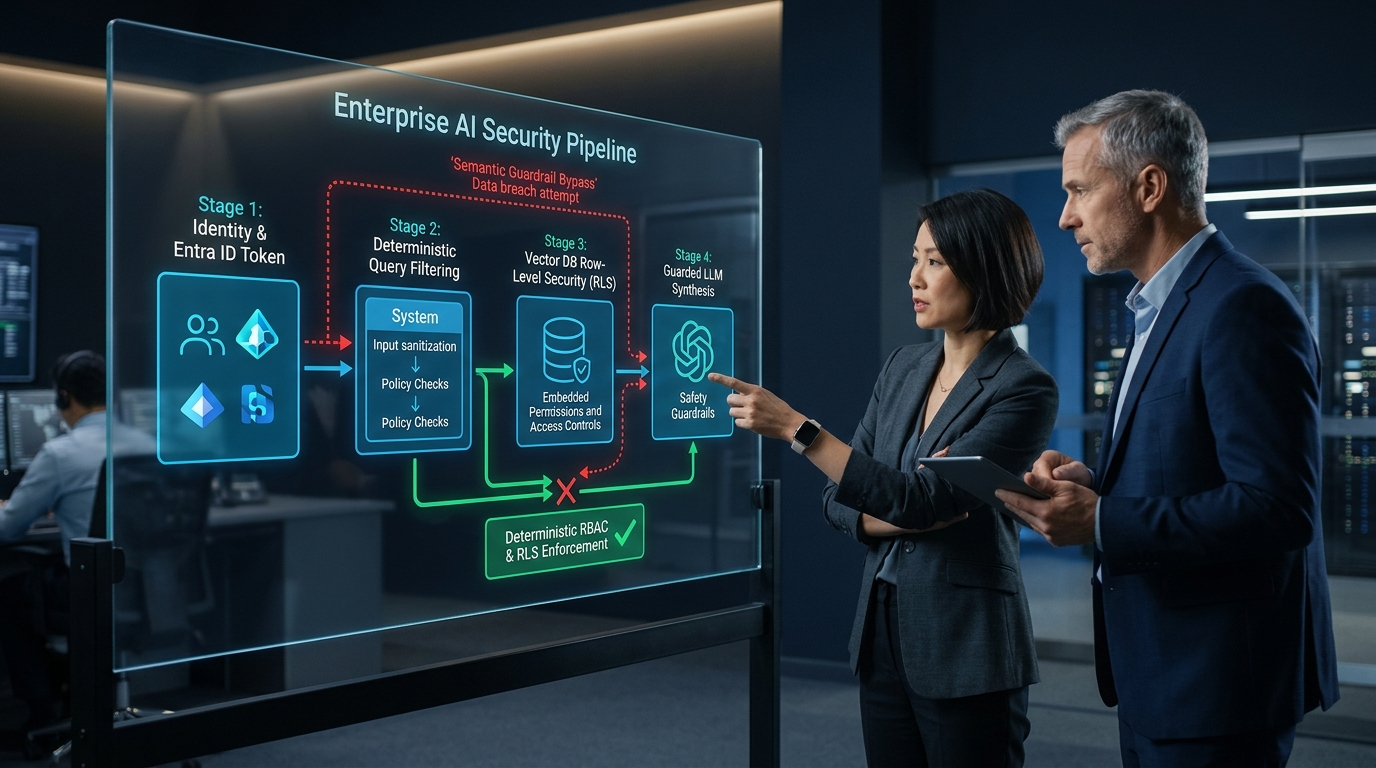
To visualize the difference between these two paradigms, study the operational comparison below. Notice how the flawed architecture leaks data inside the retrieval stage, whereas the Zero-Trust architecture blocks unauthorized data mathematically before vector synthesis:
❌ THE FLAWED ARCHITECTURE: Semantic Guardrail Reliance
HIGH DATA LEAKAGE RISK
In this common anti-pattern, user identity is discarded at the app gateway. The search service queries a flat vector index using an administrative master key, returning high-privilege documents directly into the prompt.
Step 2: App calls Vector DB via Shared Global Admin Service Account.
Step 3: Vector Search performs pure similarity search across entire enterprise corpus.
Step 4: Vector DB returns Top-5 chunks (including unreleased executive compensation & M&A files).
Step 5: Sensitive chunks injected into LLM Prompt Context alongside a system prompt: “Please do not share salaries.”
Step 6: DATA BREACH: Prompt injection, indirect query, or analytical framing causes LLM to summarize confidential rows back to the user.
✅ THE ZERO-TRUST ARCHITECTURE: Deterministic Pre-Retrieval Filtering
AUDIT-READY ZERO LEAKAGE
In the zero-trust architecture, user identity is cryptographically validated and propagated. The vector and relational engines enforce Access Control Lists (ACLs) and Row-Level Security (RLS) before results leave the database.
Step 2: Identity context extracts user’s assigned Security Groups, Business Units, and Role IDs.
Step 3: Search Orchestrator constructs an Enforced Query Filter Clause requiring matching security group IDs.
Step 4: Vector / Search Engine applies mathematical pre-filtering. Confidential chunks are physically invisible to the query.
Step 5: Only authorized, sanitized chunks enter the LLM Context Window.
Step 6: PROVEN ISOLATION: Even if the user executes an aggressive jailbreak, the LLM cannot hallucinate or leak data it never received.
4. The 3 Fatal Sins of Naive Enterprise RAG Implementations
When enterprise security teams perform post-incident forensics on AI data breaches, the root cause is almost never an unpatched zero-day vulnerability in the LLM. It is invariably one of three foundational architectural oversights:
Fatal Sin #1: The Ingestion Superuser (The Flat Index Anti-Pattern)
When building an enterprise RAG prototype, data engineers typically run a scheduled batch crawler against SharePoint, Google Drive, Microsoft Dataverse, or corporate file shares. To avoid permission errors during development, the crawler is given a global service account with administrative read privileges across every site collection.
The crawler parses documents, segments them into text chunks, calculates high-dimensional embeddings, and stores them in a single, monolithic vector collection. In doing so, the engineers have destroyed the enterprise security boundary: the original file permissions, SharePoint group ACLs, and ERP security roles are completely stripped away, creating a flat database where top-secret board slides sit next to the public cafeteria menu.
Fatal Sin #2: The Identity-Stripped API Gateway
When a user logs into a corporate portal, Power App, or web client, they authenticate with their individual corporate identity (such as Microsoft Entra ID). However, when the frontend sends the user’s natural language question to the backend RAG microservice, developers frequently strip the user’s token.
Instead of executing the downstream search on behalf of the calling user, the backend executes the search using a shared database connection string or a master API key. The search engine treats the query as coming from an omniscient administrator, returning every semantically relevant piece of data in the company.
Fatal Sin #3: Post-Retrieval Prompt Filtering (The Band-Aid Anti-Pattern)
Realizing that the search engine is returning confidential documents, teams frequently attempt a hasty patch: they add a classification model or prompt rule after retrieval. “Check the retrieved chunks. If a chunk contains sensitive data, instruct the model not to mention it.”
This approach is fatally flawed. Once sensitive tokens enter the prompt context, they influence the generative distribution of the entire completion. Even if the model does not repeat the raw numbers verbatim, it will inadvertently leak directional truths: confirming ranges, acknowledging that specific individuals are on termination schedules, or leaking strategic intentions through negative inference.
5. The 4-Tier Deterministic Security Architecture for Enterprise RAG
To achieve true zero-leakage enterprise AI, systems architects must implement a four-tiered security architecture where authorization is enforced deterministically at every phase of the pipeline:
Tier 1: Identity Propagation via Delegated Tokens (OAuth 2.0 On-Behalf-Of)
Eliminate shared secrets and administrative connection strings from frontend and middle-tier services. When a user submits a query inside Microsoft Power Apps, Microsoft Teams, or a custom web app, the user’s authentic identity token is passed downstream using the OAuth 2.0 On-Behalf-Of (OBO) flow.
The orchestration middleware validates the cryptographic signature of the token against your enterprise identity provider (such as Microsoft Entra ID). It extracts the caller’s unique User Principal Name (UPN), assigned Security Group Object IDs, and organizational tenant boundaries.
Tier 2: Ingestion-Time Metadata ACL Tagging
During the document chunking and indexing lifecycle, the data pipeline must capture the authoritative security metadata from the source repository and embed it directly into the search index schema as filterable attributes.
Every single chunk must store: (1) Allowed Security Group IDs, (2) Departmental or Business Unit IDs, (3) Document Confidentiality Classification (e.g., Public, Internal, Confidential, Restricted), and (4) Individual Explicit Read Access Claims. If a source document has restricted permissions in SharePoint or Dataverse, those exact permission identifiers must accompany every vector chunk.
Tier 3: Enforced Pre-Retrieval Deterministic Filtering
When the search request is submitted to the vector or hybrid search engine (such as Azure AI Search, PostgreSQL with pgvector, or Milvus), the search orchestrator injects an unmodifiable filter expression based directly on the validated token claims from Tier 1.
The search engine executes the security filter first, pruning the search space to only those documents and chunks the user is authorized to read. The vector similarity comparison occurs solely within that authorized subset. If an unauthorized chunk contains the absolute highest semantic similarity score in the entire corpus, the database engine will not evaluate it and will never return it.
Tier 4: Enterprise Defense-in-Depth (Auditing & Sanitization)
Guardrails, content safety filters, and PII anonymization are reintroduced—not as primary gatekeepers, but as secondary defense-in-depth safety layers.
At this tier, automated systems monitor for prompt injection attempts, mask incidental personal identifiable information (such as credit card numbers or Social Security digits), enforce executive communication standards, and generate immutable, tamper-resistant audit records detailing who queried what, which authorization claims were evaluated, and which document chunks were synthesized.
6. Enterprise RBAC & Row-Level Security Enforcement Matrix
In a properly governed enterprise RAG environment, users across different departments and operational tiers can ask the exact same natural language question, yet receive completely different, deterministically partitioned results based on their assigned security roles:
| Enterprise Persona | User Query Submitted | Pre-Retrieval Filter Applied | Result Generated by AI |
|---|---|---|---|
| Executive / C-Suite | “Summarize Q4 compensation adjustments and bonus pools.” | Security Group: Executive_Leadership Access Scope: Global / Tier-1 Restricted |
Complete corporate breakdown across executive leadership, VP tiers, and board compensation benchmarks. |
| Department Director (Operations) | “Summarize Q4 compensation adjustments and bonus pools.” | Security Group: Operations_Management Row-Level Filter: Dept_ID eq ‘OPS-200’ |
Detailed summary restricted strictly to the operations division. Zero visibility into executive, sales, or finance compensation. |
| Frontline Employee (Staff Analyst) | “Summarize Q4 compensation adjustments and bonus pools.” | Security Group: General_Staff Confidentiality Filter: Public_Only |
High-level overview of the company-wide holiday calendar and general bonus distribution timeline. Zero compensation metrics. |
| External Contractor / Vendor | “Summarize Q4 compensation adjustments and bonus pools.” | Security Group: External_Guest Isolation Filter: Vendor_Specific_Only |
“No matching operational records found for your account access profile.” |
Notice that the frontline employee and external contractor did not trigger a dramatic red security error box, nor did they receive a message saying “I cannot reveal this secret to you.” Instead, the system deterministically returned zero matching records because those records did not exist within their authorized mathematical universe. This prevents attacker reconnaissance: unauthorized users cannot even verify whether sensitive files exist in the system.
7. The Enterprise CISO AI Audit: 7 Mandatory Pre-Deployment Tests
Before signing off on any production deployment of an internal Copilot, autonomous AI agent, or RAG-based knowledge assistant, enterprise Chief Information Security Officers (CISOs) and lead security architects should mandate the following seven verification criteria:
- Elimination of Administrative Service Credentials: Does the vector search gateway query databases using individual user identity tokens (OAuth 2.0 On-Behalf-Of) rather than an all-powerful global read-all credential?
- Metadata ACL Completeness at Chunk Level: Does every indexed text chunk and vector record carry explicit Access Control Lists representing source repository permissions?
- Mandatory Pre-Retrieval Enforcement: Is security filtering executed before vector similarity scoring, guaranteeing that unauthorized chunks are physically excluded from top-K results?
- Absence of Context Window Contamination: Has the engineering team mathematically proven that unauthorized data never enters the LLM prompt context, regardless of prompt phrasing?
- Auditability of Filter Clauses: Can security operations inspect query telemetry in Azure Application Insights or Datadog to verify the exact filter parameters applied to every user query?
- Jailbreak Resilience Through Physical Isolation: If a red-team tester executes an adversarial prompt injection, is the AI completely incapable of leaking confidential data simply because the data is absent from its context?
- Lifecycle Permission Synchronization: When an employee transfers departments or leaves the organization, do their access permissions update immediately across the AI search engine without requiring a full re-indexing of the vector database?
8. Frequently Asked Questions (FAQ)
Why can’t commercial AI safety guardrails (like NeMo or Azure AI Content Safety) be trusted for access control?
Commercial AI safety guardrails are designed for content moderation, profanity detection, toxicity filtering, and prompt injection defense. They evaluate language semantics statistically. They do not maintain real-time mappings of your organization’s Active Directory groups, departmental cost centers, or record-level ERP security filters. Using a language classifier for access control is fundamentally unsafe because human language is infinitely flexible: an authorized query and an unauthorized query often use identical words with slightly different business contexts.
How does pre-retrieval security filtering impact query latency in enterprise vector databases?
Counterintuitively, pre-retrieval security filtering almost always improves query performance. By filtering the vector index against user security groups first, the search engine dramatically reduces the candidate search space before calculating expensive vector similarity metrics (such as cosine similarity or Euclidean distance). Modern vector search engines (including Azure AI Search and PostgreSQL with pgvector) execute indexed boolean metadata filters in single-digit milliseconds, resulting in faster end-to-end response times and reduced compute costs.
What happens when a user’s permissions change in Active Directory? Does the vector database need to be re-indexed?
No, provided the architecture tags chunks with Security Group Object IDs rather than individual user accounts. When an employee moves from Operations to Executive Finance, their Entra ID group membership updates immediately. On their very next query, their new OAuth token carries the Executive Security Group claim. The search orchestrator immediately includes executive-tagged chunks in their pre-retrieval filter. Zero re-indexing or vector calculation is required for user permission updates.
Can Row-Level Security (RLS) be applied to structured ERP databases like Dynamics 365 Business Central and Dataverse in an AI pipeline?
Yes. In hybrid architectures connecting AI agents to Dynamics 365 Business Central or Dataverse, the AI pipeline executes queries through Dataverse Virtual Tables or compiled AL API endpoints signed with the user’s delegated identity. Business Central automatically enforces native Security Filters and Responsibility Centers; Dataverse automatically enforces Business Unit and Security Role hierarchies. The AI agent physically cannot retrieve rows that the user does not have permission to view in the native ERP client.
Enterprise AI Architecture Practice
Architecting Zero-Leakage Enterprise AI with Allgrow Technologies
At Allgrow Technologies, our cloud security and enterprise AI practice leads help Fortune 500 enterprises, defense contractors, and high-growth organizations architect audit-ready, Zero-Trust RAG pipelines across Microsoft Azure, Dynamics 365, and Power Platform. From pre-retrieval ACL enforcement to private VNet tenant isolation, we ensure your AI agents empower your workforce without compromising data sovereignty.