
Executive Briefing: Navigating Florida’s Real Estate Tax & Development Complexity
- The Unique Commercial Rent Tax: Florida is the only state in the United States that levies sales tax on commercial real estate leases (Florida Statutes § 212.031). Operating across Florida requires calculating the 2.0% state rate plus 67 distinct county discretionary surtaxes on base rent, CAM, and property tax pass-throughs.
- Special Purpose Entity (SPE) Sprawl: Florida developers insulate real estate assets by forming separate LLCs/SPEs for each parcel and joint venture. Managing 30+ separate entities in entry-level accounting software causes month-end reporting collapse and manual intercompany reconciliation errors.
- ASC 606 & Percentage-of-Completion (PoC): Commercial general contractors and developer-builders require real-time project accounting in Microsoft Dynamics 365 Business Central to generate AIA G702/G703 progress billings, accurately recognize earned revenue, and isolate cost-to-complete variances.
- Subcontractor Retainage & Florida Lien Law: Florida Construction Lien Law (F.S. Chapter 713) mandates strict Notice to Owner (NTO) compliance. Automating conditional and unconditional lien waiver collection before releasing 5% to 10% retainage disbursements is essential to prevent secondary owner liability.
- Enterprise Scale: By implementing Business Central with multi-company intercompany automation, Florida developers eliminate duplicate data entry, ensure audit-ready sales tax compliance with the Florida Department of Revenue, and consolidate investor cash flow reporting in real time.
1. Florida Commercial Real Property Lease Tax: Statutory Rules & Tax Area Calculations
Florida occupies a singular position in American state taxation: under Florida Statutes Section 212.031, it is the only state in the nation that imposes state sales tax on the total rent charged for the use or occupancy of commercial real property. For institutional landlords, asset managers, and property developers managing retail strips, industrial parks, or Class-A office towers in South Florida, Tampa Bay, Orlando, and Jacksonville, configuring tax calculation rules in your ERP is a critical compliance mandate.
Effective June 1, 2024, Florida lowered the state-level tax rate on commercial real property rentals from 4.5% to 2.0%. However, this state rate reduction does not eliminate local taxation. Landlords are still statutorily required to collect local Discretionary Sales Surtax levied by individual Florida counties.
| Florida County / Commercial Hub | State Lease Tax Rate | County Discretionary Surtax | Combined Commercial Lease Tax Rate |
|---|---|---|---|
| Miami-Dade County | 2.0% | 1.0% | 3.0% |
| Broward County (Fort Lauderdale) | 2.0% | 1.0% | 3.0% |
| Palm Beach County (West Palm Beach) | 2.0% | 1.0% | 3.0% |
| Orange County (Orlando) | 2.0% | 0.5% | 2.5% |
| Hillsborough County (Tampa) | 2.0% | 1.5% | 3.5% |
| Duval County (Jacksonville) | 2.0% | 1.5% | 3.5% |
A frequent audit trap for commercial landlords during Florida Department of Revenue (FDOR) reviews involves misidentifying what constitutes “taxable commercial rent.” Under F.S. § 212.031, taxable rent encompasses far more than base contractual rent:
- Base Contractual Rent: Minimum monthly rental consideration paid by the tenant.
- Common Area Maintenance (CAM): Tenant reimbursements for landscaping, security, parking lot maintenance, and HVAC servicing.
- Ad Valorem Property Taxes Paid by Tenant: In triple-net (NNN) leases, property taxes paid by the tenant directly to the landlord or local tax collector are deemed taxable rent consideration.
- Building Insurance Premiums: Hazard and liability insurance premiums reimbursed by tenants under lease covenants.
- Tenant Improvement Allowances & True-Ups: Year-end operational expense reconciliations that result in additional tenant billings.
Within Microsoft Dynamics 365 Business Central, we architect this by configuring Tax Area Codes mapped to specific Florida County jurisdictions, linking each property asset dimension to its corresponding tax schedule. When automated recurring lease billing runs or annual CAM true-ups post, Business Central calculates the precise combined state (2.0%) and county surtax, routing the tax liabilities to dedicated FDOR payable ledger accounts for seamless DR-15 sales and use tax filing.
2. Multi-Entity SPE Architecture: Consolidations, Intercompany Postings & Centralized Cash Sweeps
To shield capital and isolate liability, Florida commercial developers and asset owners routinely construct a Special Purpose Entity (SPE)—typically a single-member LLC, LP, or joint venture—for every distinct parcel, speculative development, or income-producing building. A regional development firm might manage 25 to 75 separate legal entities across commercial office, multifamily, and industrial sectors.
Operating this multi-entity structure in disconnected platforms like QuickBooks Enterprise or legacy Sage creates operational paralysis. Accounting teams spend days each month exporting general ledgers into fragile Excel spreadsheets, manually calculating intercompany loans, management fee allocations, and partner equity roll-ups.
In Microsoft Dynamics 365 Business Central, multi-entity operations are unified within a single cloud database environment without requiring separate software instances:
- Centralized Chart of Accounts & Global Dimensions: Maintain standardized account hierarchies across all SPEs while using global dimensions (Property Code, Phase, Asset Class, Investor Partner) for granular operational filtering.
- Automated Intercompany General Journals: When the central management company incurs an expense on behalf of an SPE (such as regional property insurance or legal zoning retainer), posting the transaction automatically generates offsetting intercompany receivable and payable entries in both companies simultaneously—eliminating out-of-balance intercompany reconciliations.
- Automated Elimination & Consolidation Runs: Business Central’s native consolidation module automatically aggregates financial statements across all operating LLCs, programmatically eliminating intercompany management fees, debt service, and internal distributions to present clean GAAP consolidated balance sheets and cash flow statements for institutional lenders.
- Treasury & Centralized Banking: Process batch electronic disbursements across multiple Florida banking institutions (such as Wells Fargo, Bank of America, or regional Florida commercial banks) using native NACHA ACH formatting while maintaining strict entity segregation.
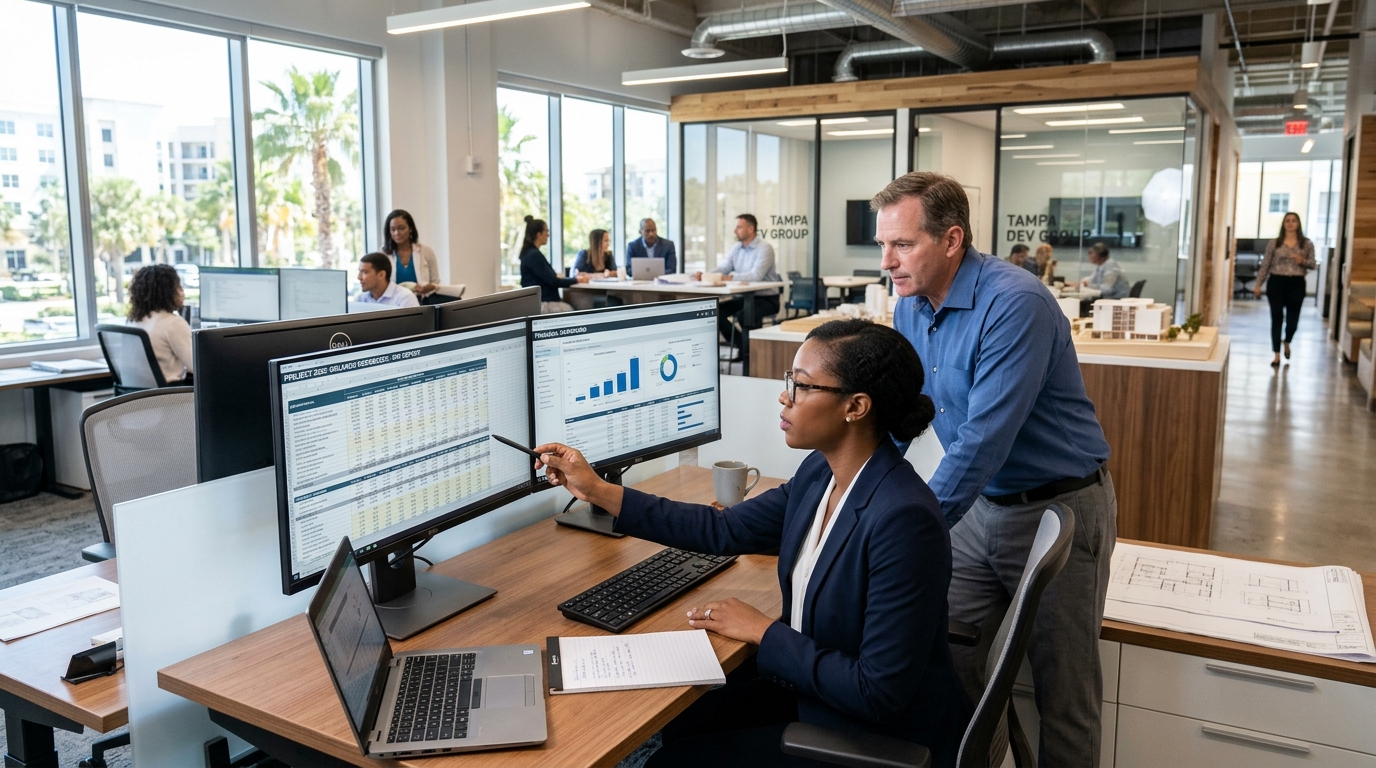
D365 Project Management & WIP
3. Construction Job Costing & ASC 606 Percentage-of-Completion (PoC) Revenue Recognition
For Florida general contractors and commercial developer-builders executing vertical commercial, multi-family, or high-density mixed-use developments, accurate cost tracking against committed budgets is vital. Inflation in construction labor and materials—combined with Florida-specific hurricane mitigation building codes (HVHZ)—requires continuous visibility into cost-to-complete metrics.
Under ASC 606 (Revenue from Contracts with Customers), construction contractors must recognize contract revenue over time using the input method based on costs incurred relative to total estimated contract costs (Percentage-of-Completion). Miscalculating cost-to-complete distorts WIP balances and can trigger catastrophic over-billing penalties or restatements during institutional financial audits.
Business Central’s Project Management (Jobs) architecture provides end-to-end visibility across the entire project lifecycle:
- Hierarchical Work Breakdown Structure (WBS): Projects are structured into Project Tasks and Planning Lines aligned with standard CSI MasterFormat cost codes (e.g., Division 03 Concrete, Division 05 Metals, Division 26 Electrical).
- Committed Cost Tracking: Purchase orders and subcontract agreements immediately record committed costs against project task lines upon issuance. Project managers view real-time comparisons of Original Budget vs. Approved Change Orders vs. Revised Budget vs. Committed Costs vs. Actual Costs Incurred.
- Automated WIP Revenue Calculation: Business Central evaluates actual recognized project expenses against total forecasted budget lines to dynamically calculate Percentage of Completion. At month-end, the system automatically posts balancing journal entries to Costs in Excess of Billings (Unbilled Receivables) or Billings in Excess of Costs (Deferred Revenue), ensuring total GAAP compliance.
- AIA G702 & G703 Progress Billing: Generate standardized AIA Document G702 (Application and Certificate for Payment) and G703 (Continuation Sheet) directly from project task lines, tracking previous applications, current work completed, stored materials, and retainage holdbacks with zero manual transcriptions.
4. Subcontractor Compliance: Statutory Retainage & Florida Lien Waiver Automation
Florida’s commercial construction sector operates under stringent statutory frameworks designed to protect property owners, general contractors, and trade subcontractors from mechanic’s liens. Under Florida Statutes Chapter 713 (Construction Lien Law), a property owner who fails to secure proper lien waivers prior to disbursing payments risks secondary liability—meaning the owner can be forced to pay twice if a general contractor fails to pay downstream trade subcontractors or material suppliers.
Managing this compliance manually across dozens of trade subcontractors (electrical, plumbing, structural concrete, glazing) is a high-risk operational vulnerability. Within Business Central, we deploy an integrated subcontractor governance framework:
| Compliance Milestone | Florida Statutory Requirement (F.S. Ch. 713) | Business Central / Power Platform Enforcement |
|---|---|---|
| Notice to Owner (NTO) | Must be served within 45 days of commencing work or delivering materials. | Subcontractor record is tagged with NTO tracking. Automated alert flag blocks payment processing if NTO is unverified. |
| Progress Retainage (5% – 10%) | Statutory retainage held from progress applications until substantial completion. | Automated retainage holdback lines configured on Subcontract Purchase Orders, posting retainage to a dedicated non-current AP liability account. |
| Partial Conditional Lien Waiver | Subcontractor certifies waiver of lien rights contingent upon receipt of progress draw. | Automated Power Automate disbursement gate: ACH release is blocked until digital signature of Partial Conditional Lien Waiver is uploaded. |
| Final Unconditional Lien Waiver | Absolute release of all lien claims upon disbursement of final retainage. | Retainage release batch routine requires verification of Final Unconditional Waivers from both Tier-1 subs and Tier-2 suppliers. |
| Certificate of Insurance (COI) | Active General Liability, Workers’ Comp, and Excess Umbrella coverage. | Vendor card holds active expiration dates. Automated job queue freezes invoice approvals 15 days prior to policy expiration. |
By coupling Business Central purchase invoices with automated approval gates, finance teams eliminate the risk of accidental payment release to non-compliant trades, ensuring Florida real estate developers and lenders maintain unencumbered title throughout the construction cycle.
5. Tangible Personal Property (DR-405) & Florida Corporate Tax Structuring
Beyond sales tax and project WIP, Florida commercial operators must manage annual Tangible Personal Property (TPP) Tax obligations. All commercial equipment, construction machinery, office furniture, tenant improvements, and tech infrastructure located in Florida on January 1 are subject to ad valorem TPP taxation assessed by county property appraisers.
Every commercial entity owning tangible assets must file Form DR-405 with the local county property appraiser by April 1 annually. In multi-entity developer structures with dozens of LLCs, managing asset classification, acquisition years, and depreciation schedules manually in spreadsheets is an arduous, error-prone task.
Dynamics 365 Business Central’s Fixed Assets module streamlines Florida TPP compliance:
- Dual Depreciation Books: Configure parallel depreciation books within the same asset record—one book for Financial GAAP reporting (Straight-Line) and a secondary book for Florida TPP assessment (County Depreciation Guidelines).
- County Asset Segregation: Tag assets with county location codes to automatically generate asset roll-forward reports matching Florida DR-405 property class categories (e.g., Office Furniture, Computer Equipment, Leasehold Improvements, Construction Machinery).
- Florida Corporate Income Tax (5.5%): Florida levies a 5.5% corporate income tax on C-corporations and entities electing corporate status. Business Central’s global dimension tagging enables seamless state-level apportionment calculations, separating Florida-sourced revenue from multi-state operations for clean Florida Form F-1120 filings.
⚡ Florida Enterprise ERP Practice
Modernizing Real Estate & Construction Operations in Florida?
Allgrow Technologies architects tailored Microsoft Dynamics 365 Business Central implementations for Florida real estate developers, general contractors, and asset managers. We automate commercial lease sales tax, multi-entity SPE consolidation, and Florida lien waiver compliance.
6. Systems Integration: Unifying Business Central with Procore, Banks & Power BI
Modern Florida developers and contractors do not operate Business Central in an isolated silo. True operational velocity requires an integrated ecosystem connecting field operations, executive analytics, and banking rails:
Enterprise Integration Topology for Florida Construction & Development
- Field-to-Finance Procore Sync: Bi-directional synchronization between Procore and Business Central using Azure Service Bus and webhooks. Subcontractor commitments, daily logs, and owner change orders sync automatically without double entry.
- Executive Investor Portals via Power BI: Build dynamic investor dashboards visualizing multi-property NOI (Net Operating Income), occupancy percentages, debt service coverage ratios (DSCR), and construction draw schedules updated directly from Business Central SIFT flowfields.
- Automated Bank Reconciliation: Direct cloud feeds connecting Florida commercial banks (Wells Fargo, Truist, Synovus) to Business Central for automated statement ingestion and algorithmic cash matching rules.
- Vendor & Investor Self-Service Portals: Secure external access built on Microsoft Power Pages allowing trade subcontractors to check retainage balances and submit payment draw applications securely.
7. Frequently Asked Questions
Does the reduction in Florida commercial rent tax to 2.0% eliminate county surtaxes?
How does Dynamics 365 Business Central manage 50+ property LLCs without multiplying user license costs?
Can Business Central generate standard AIA G702 and G703 progress billing forms?
How does Business Central prevent payments from being released without signed Florida lien waivers?
Can we migrate from Yardi, Sage 300 CRE, or QuickBooks to Business Central without losing historical project data?