
In Manufacturing R&D, your company’s market capitalization and enterprise moat do not live in your physical real estate or stainless-steel blending vessels. They live in your formulation intellectual property (IP): the exact ratios, reaction kinetics, active ingredient concentrations, and molecular sequences that make your product outperform competitors.
This challenge spans a diverse spectrum of high-value manufacturing sectors:
- Specialty Chemicals & Agrochemicals: Patented micronutrient chelates, agricultural adjuvants, and specialty catalysts.
- Biopharma & Life Sciences CDMOs: Clinical-stage drug formulations, sterile reagents, and buffer solutions.
- Food & Beverage Science: Proprietary flavor extracts, enzymatic nutritional bases, and stabilized beverage emulsions.
- Advanced Materials & Polymers: Proprietary composite resins, thermal barrier coatings, and engineered elastomers.
- Industrial Coatings, Sealants & Adhesives: High-durability polyurethanes, aerospace adhesives, and corrosion inhibitors.
When enterprise leaders in these sectors scale operations, a critical executive dilemma emerges:
The Manufacturing R&D Costing Dilemma
Finance & Operations: “We need granular, real-time COGS. We must track every gram of raw material, labor minute, and machine overhead to protect our margins.”
Founders & R&D Scientists: “Our formulations are our corporate crown jewels. No developer, external vendor, or shop-floor worker can ever be allowed to see our exact recipe.”
Most companies attempt to navigate this tension using entry-level accounting software or generic ERP setups by making one of two fatal compromises:
- They surrender their secrets: They enter raw chemical names, CAS numbers, and supplier unit prices directly into standard Bill of Materials (BOM) lines—exposing their proprietary moat to internal developers, external implementation contractors, and database administrators.
- They surrender their financial visibility: Terrified of leaks, R&D keeps formulation data isolated in offline spreadsheets, passing rough lump-sum figures to accounting at month-end. As a result, the C-suite flies blind—unable to identify true gross margin per batch, machine scrap leakages, or overtime labor variance.
There is a superior path. By utilizing the enterprise infrastructure of Microsoft Dynamics 365 Business Central and Microsoft Azure, high-value Manufacturing R&D leaders can calculate razor-sharp, real-time COGS across materials, burdened labor, and overhead absorption—while ensuring that the development team and shop floor only ever see an encrypted, tokenized composite value.
Part 1: The Chemistry of a Data Leak (Why Traditional ERPs Expose Your Moat)
Most executives believe non-disclosure agreements (NDAs) and standard role-based security protect their trade secrets. In modern industrial R&D, corporate recipes are rarely stolen via an obvious file download. Instead, formulas are routinely reverse-engineered through price-density-volume correlation.
The Reverse-Engineering Scenario: Commodity Price Fingerprinting
Consider a specialty chemical manufacturer producing an agricultural foliar chelate. During an ERP rollout, the development team configuring the production module in a test sandbox has access to the standard production BOM lines:
[BOM Line 20] Raw Material: Carrier Solvent A | Qty: 80.0 Liters | Unit Cost: $1.15/L
[BOM Line 30] Raw Material: Surfactant Blend | Qty: 7.5 Liters | Unit Cost: $8.50/L
Even if the R&D team disguises the item description as “Liquid Compound X”, the combination of:
- The physical volume ratio (12.5% of the total batch volume),
- The exact unit cost bracket ($20.40/L), and
- The operational context (pH-balancing agricultural chelate),
creates an unmistakable digital fingerprint.
An engineer, contractor, or automated AI model querying global chemical databases (such as Sigma-Aldrich, Brenntag, or Alibaba Bulk) can cross-reference physical volume and spot market pricing to identify the hidden compound within seconds as Ethylenediaminetetraacetic acid (EDTA) or a specific iron chelate analog.
The Commodity Fingerprint Vulnerability
If an ERP records raw, unbundled purchase costs and volume ratios on production lines, your proprietary formulation is fingerprintable. A developer or system administrator can deduce your active compounds simply by cross-referencing commodity market prices against your BOM percentages.
Part 2: The “QuickBooks Ceiling” in Formulation Manufacturing
Growing process manufacturers frequently hit what we call the “QuickBooks Ceiling.” Entry-level accounting tools were designed for basic mercantile businesses—buying a box for $10 and selling it for $15. In complex manufacturing R&D, their flat permission model becomes an existential security liability:
| Operational Dimension | QuickBooks / Entry-Level Systems | Dynamics 365 Business Central + Azure |
|---|---|---|
| Data Visibility Model | All-or-Nothing: If a developer or bookkeeper has inventory access, they can view every raw vendor invoice, chemical name, and unit cost. | Zero-Trust Segregation: Developers write extensions and logic against tokenized schemas without ever viewing confidential production data. |
| Formula Isolation | None: Anyone with a backup file (.QBW) can export the entire recipe book to an Excel spreadsheet in under five minutes. | Air-Gapped Tokenization: Raw formulation logic resides in an encrypted Azure Key Vault, passing only synthetic precursor values into the ERP. |
| Overhead Allocation | Manual Estimates: Machine wear, high-shear power consumption, and cleanroom HVAC cannot be absorbed into inventory. | Automated Work Center Costing: Direct absorption of fixed and variable machine center overhead per runtime minute. |
| Labor Burdening | Flat Wage Averages: Fails to calculate true burdened cost (payroll taxes, health benefits, shift differentials, and overtime). | True Burdened Cost Routing: Real-time labor variance calculated via kiosk Power Apps without exposing worker wages. |
| Lot Genealogy | Basic Manual Notes: Incapable of multi-tier forward and backward tracing across parent-child precursor batches. | Sub-Second Bi-Directional Tracing: Instant forward and backward recall reporting from raw precursor token to finished customer shipment. |
Part 3: The Microsoft Solution Architecture (The Zero-Knowledge Formula Vault)
To protect your enterprise moat, your actual chemical formulas and raw recipe percentages must never touch standard ERP database tables in raw form.
Allgrow architects an air-gapped Zero-Knowledge Tokenized Architecture that integrates Microsoft Dynamics 365 Business Central with an isolated Azure security enclave:
The 4 Security Boundaries of the Architecture:
- Air-Gapped Key-Value Tokenization (Azure Key Vault): The internal R&D chemistry or formulation team maintains the master recipe catalog outside the ERP in an encrypted Azure Key Vault database. Instead of sending raw chemical compounds into Business Central, R&D bundles them into an abstracted sub-assembly token:
PRECURSOR-TOKEN-742. - Synthetic Transfer Valuation: The true supplier costs and compounding percentages are aggregated by a secure, air-gapped Azure Function that calculates a single, blended composite transfer cost $X$. The developer debugging Business Central only sees
PRECURSOR-TOKEN-742at $142.50. They cannot determine which compounds comprise that unit or what spot prices were paid. - Sealed Phantom Assemblies: Inside Business Central,
PRECURSOR-TOKEN-742is managed as a closed sub-assembly. Even if an administrator queries the standard Bill of Materials tables, no underlying chemical lines exist. Reverse-engineering is mathematically impossible. - Microsoft Entra ID Just-In-Time (JIT) Privileged Access: Developers operate strictly within sanitized developer sandboxes containing synthetic mock tokens. All custom enhancements are deployed via automated Azure DevOps CI/CD pipelines without human developers accessing production databases.
Part 4: Managing the 3 Pillars of True COGS in Business Central
Once your proprietary formulation is sealed behind tokenized precursors, how does Business Central provide the C-suite with complete financial operational truth?
True Cost of Goods Sold is composed of three interconnected pillars:
True COGS = Direct Precursor Material + Direct Burdened Labor + Absorbed Manufacturing Overhead
│ TRUE COGS STRUCTURE IN BUSINESS CENTRAL │
├────────────────────────────────────────────────────────────────────────┤
│ 1. DIRECT MATERIAL (Tokenized Precursor Base) │
│ • 1 unit of PRECURSOR-TOKEN-742 …………………… $142.50 │
│ • Commercial Primary Packaging / Sterile Container …… $ 1.20 │
│ • Tamper-Evident Induction Seal & Label …………….. $ 0.35 │
├────────────────────────────────────────────────────────────────────────┤
│ 2. DIRECT BURDENED LABOR (Routing Center 10 – Blending) │
│ • Machine Operator: 0.25 hrs @ $28.00/hr ……………. $ 7.00 │
│ • Payroll Tax, Healthcare & Benefit Burden (+32%) ……. $ 2.24 │
├────────────────────────────────────────────────────────────────────────┤
│ 3. MACHINE & VARIABLE OVERHEAD (Routing Center 20 – Reactor Run) │
│ • High-Shear Agitation Power & Utilities ……………. $ 3.40 │
│ • Tooling, Nitrogen Blanket & Consumable Wear ……….. $ 1.80 │
├────────────────────────────────────────────────────────────────────────┤
│ 4. FIXED OVERHEAD ABSORPTION │
│ • Cleanroom Facility Rent, HVAC & Depreciation ………. $ 4.50 │
├────────────────────────────────────────────────────────────────────────┤
│ TOTAL TRUE UNIT COGS ……………………………….. $162.99 │
└────────────────────────────────────────────────────────────────────────┘
1. Direct Material: Standard Costing vs. FIFO with Scrap Envelopes
In process manufacturing, yield loss is standard operating reality. If a 1,000-liter batch yields only 960 liters due to tank wall clinging or filtration hold-up, Business Central automatically isolates the Scrap Variance:
- The ERP records the expected standard consumption (1,000 L).
- The actual finished output is posted (960 L).
- The 40-liter discrepancy is automatically debited to your General Ledger’s Manufacturing Material Usage Variance account. Plant managers immediately see physical yield loss without distorting baseline standard costs.
2. Burdened Labor Tracking via Shop-Floor Power Apps Kiosks
A frequent cause of understated COGS is failing to burden direct labor. If an operator makes $22.00/hour, their actual cost to the enterprise is typically $31.50/hour once payroll taxes (FICA, FUTA), workers’ compensation, medical insurance, and shift differentials are factored in.
Business Central allows controllers to define a fully Burdened Cost Rate on Work Centers:
Effective Work Center Rate = Direct Wage × (1 + Indirect Fringe %) + Overhead Rate
The Shop-Floor Kiosk Workflow:
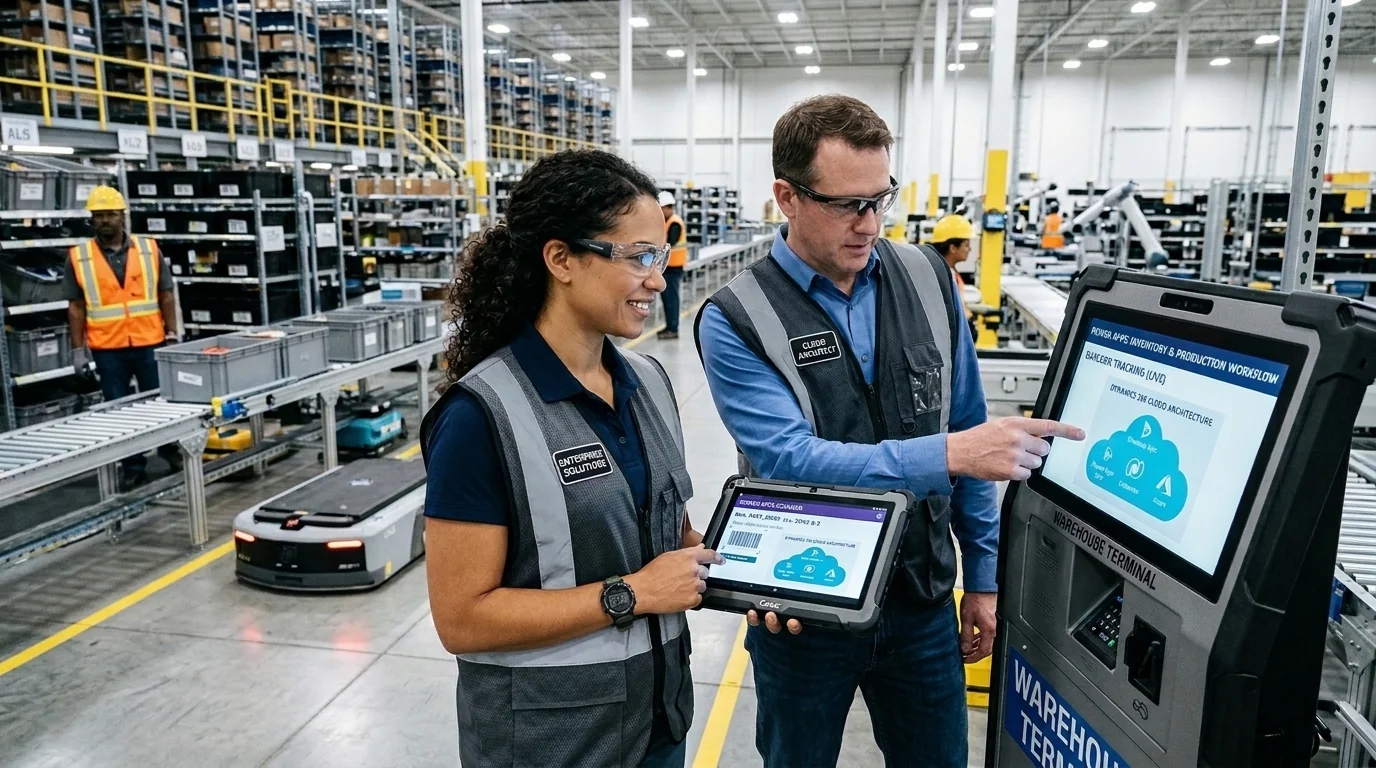
To keep wage rates confidential from operators and developers alike, Allgrow deploys a custom Power Apps Shop-Floor Kiosk mounted to the production line:
- The operator scans their badge barcode and selects the production batch number.
- The operator taps “Start Run” and “Complete Run.”
- The Power App logs the machine runtime and operator ID, writing directly to Business Central’s Capacity Ledger via Dataverse.
- Zero Financial Visibility: The operator sees only operational instructions; Business Central executes the burdened financial calculation silently behind the scenes.
3. Fixed vs. Variable Overhead Absorption
Many manufacturing companies suffer severe month-end gross margin collapse because facility overhead (plant rent, industrial refrigeration, environmental permits, quality assurance salaries) is treated as a period expense rather than being absorbed into product inventory.
Inside Business Central:
- Variable Overhead: Absorbed per machine operating hour (e.g., $45/hour for high-shear mixing power and steam utilities).
- Fixed Overhead: Absorbed across planned annual capacity hours. If a blending facility operates 4,000 hours per year with $400,000 in fixed overhead, Business Central automatically absorbs $100.00 of fixed overhead per operating hour into the asset value of inventory. When finished goods are sold, the true fully loaded cost hits COGS—ensuring margins are never overstated.
Part 5: The Executive Dashboard (Real-Time Variance Analysis)

When Business Central posts a completed production run for Product Y, the CFO’s dashboard in Power BI displays an instantaneous 4-Way Variance Waterfall:
│ EXECUTIVE 4-WAY VARIANCE WATERFALL │
├────────────────────────────────────────────────────────────────────────┤
│ STANDARD EXPECTED COST PER UNIT: $158.00 │
│ │
│ [+] Material Price Variance (Supplier Surcharge on Precursor): +$ 1.80│
│ [+] Material Usage Variance (2.4% Filtration Yield Loss): +$ 3.20│
│ [-] Capacity Efficiency Variance (Batch Finished 20 Min Fast): -$ 2.10│
│ [+] Capacity Rate Variance (Weekend Overtime Differential): +$ 2.09│
│ ─────── │
│ ACTUAL POSTED UNIT COGS: $162.99 │
│ │
│ UNFAVORABLE NET VARIANCE PER UNIT: +$ 4.99 │
└────────────────────────────────────────────────────────────────────────┘
What this real-time visibility delivers:
- Dynamic Contract Pricing: If material price variances trend positive across consecutive production runs, sales leadership can trigger index-linked contract adjustments before gross margins are compromised.
- Predictive Equipment Maintenance: If a machine center’s capacity efficiency variance is chronically unfavorable, engineering knows that agitation motors or filtration membranes are degrading long before an unexpected line failure occurs.
- Rock-Solid Audit & Valuation Defense: The enterprise maintains an unchallengeable, GAAP/IFRS-compliant inventory valuation methodology backed by immutable ledger entries.
- Complete IP Protection: The entire financial architecture operates without a single developer, outsourced consultant, or floor technician ever seeing the secret chemical formulation of
PRECURSOR-TOKEN-742.
Conclusion: Stop Compromising Between Security and Operational Truth
Moving to Microsoft Dynamics 365 Business Central is not merely an accounting modernization—it is a strategic intellectual property safeguard.
Entry-level tools force high-growth Manufacturing R&D companies into an unacceptable compromise: either risk your trade secrets by entering them into unencrypted tables, or fly blind with spreadsheets and inaccurate margins.
By combining Business Central’s native standard costing engine with Azure Key Vault tokenization, you build an unbreakable moat around your proprietary formulations while providing your executive team with the exact financial clarity needed to scale profitably.
How Allgrow Technologies Deploys Zero-Trust Formulation ERP
Allgrow Technologies specializes in architecting secure, enterprise Dynamics 365 Business Central and Power Platform environments for Manufacturing R&D leaders with high-value IP:
- Air-Gapped Formulation Vaults: We deploy isolated Azure microservices that tokenize master recipes before they touch Business Central.
- Shop-Floor Power Apps Kiosks: We build ruggedized touch terminals that record labor, scrap, and runtime without exposing wage rates or formulation secrets.
- Burdened Costing & 4-Way Variance Modeling: We configure Business Central’s General Ledger to track material, labor, and overhead variances in real time.
Schedule an Architectural Discovery Session with Allgrow Technologies →