
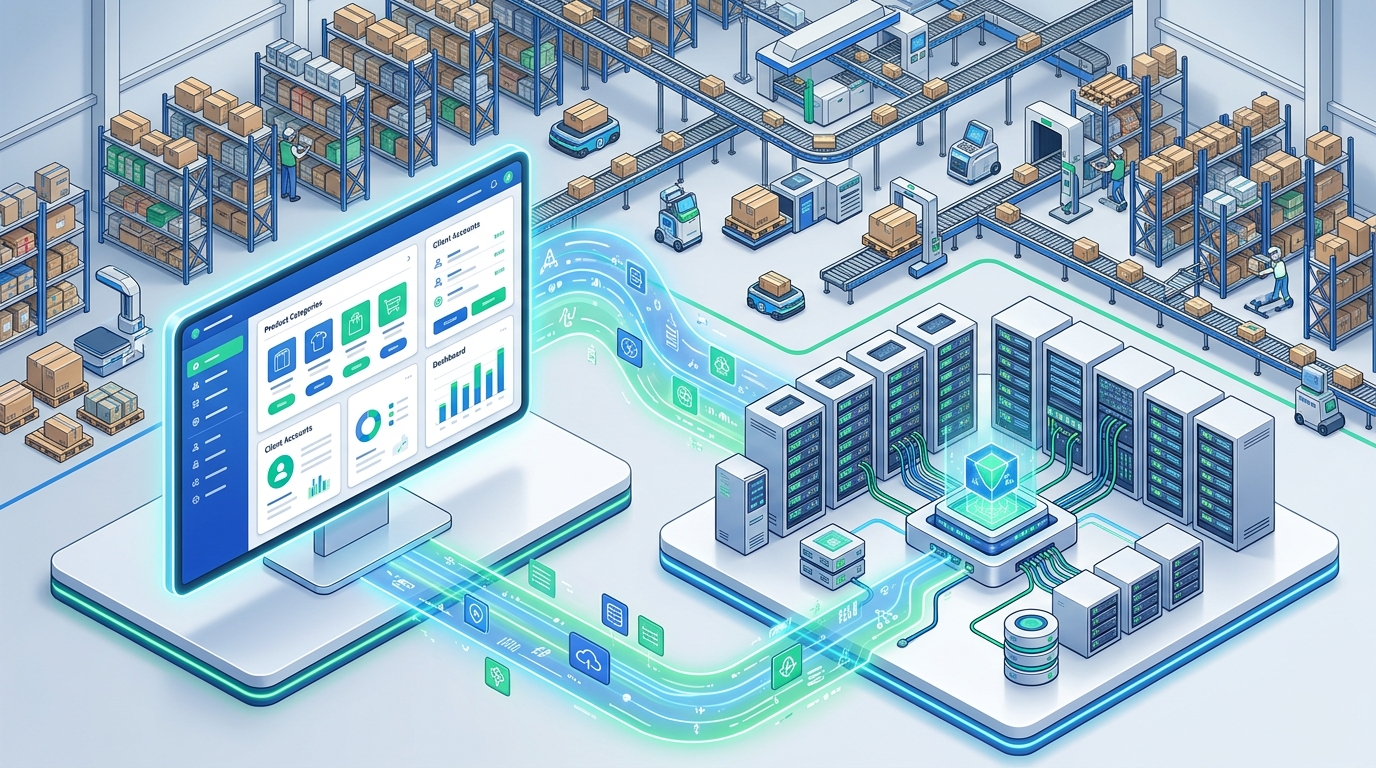
1. The Operational Friction of B2B Wholesale Commerce
Over the past twenty-four months, enterprise wholesale brands across the United States have accelerated their migration to digital self-service. Traditional wholesale order-taking—characterized by PDF line sheets, phone calls to inside sales, and manual ERP data entry—is giving way to digital portals powered by Shopify Plus B2B.
Yet, behind a polished front-end storefront, mid-market companies frequently stumble when connecting Shopify Plus to their transactional backbone: Microsoft Dynamics 365 Business Central. Unlike standard consumer (D2C) transactions, enterprise B2B commerce involves intricate financial and operational rules:
- Custom Negotiated Contract Pricing: Different wholesale buyers have bespoke pricing agreements, minimum order quantities (MOQs), and tiered volume discounts configured in Business Central customer price lists.
- Credit Limits & Payment Terms: Approved buyers do not pay via credit card; they checkout using Net 30, Net 60, or wire transfer terms subject to dynamic ERP credit limit availability.
- Multi-Location Inventory Buffering: Orders must reserve physical stock across multiple regional fulfillment warehouses (e.g., California, Texas, Ohio) without stealing inventory allocated to high-priority retail or EDI accounts.
- The Batch Polling Trap: Relying on off-the-shelf third-party connectors that poll the ERP every 15 to 30 minutes creates fatal sync lags, leading to out-of-stock cancellations, angry buyers, and customer service gridlock.
2. Architectural Blueprint: Event-Driven Enterprise Decoupling
The modern gold standard for enterprise ERP-eCommerce integration is an event-driven, asynchronous messaging pipeline. Rather than hammering Business Central with repetitive polling queries that exhaust API rate limits, our architecture utilizes reactive cloud events:
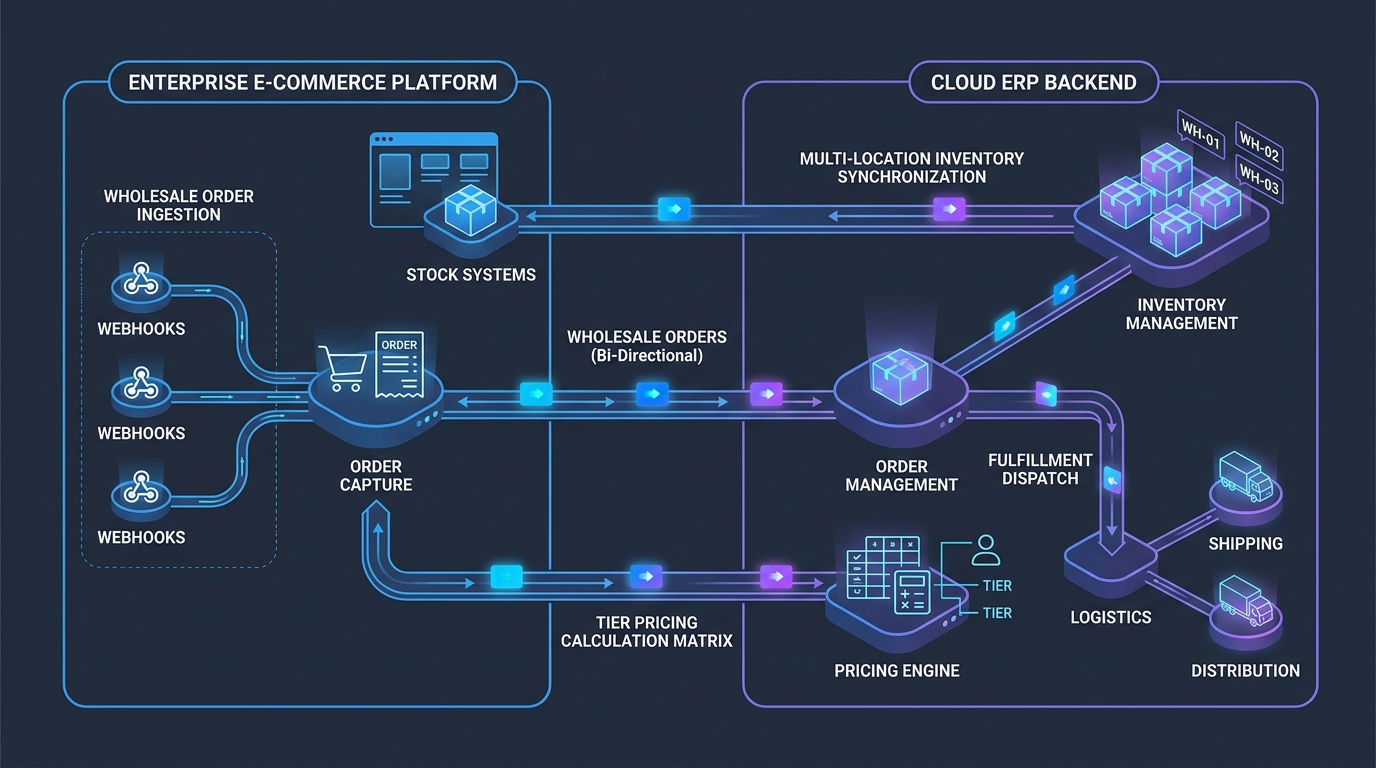
This architecture comprises four resilient cloud layers:
- Shopify Plus GraphQL Admin & B2B APIs: Leverages native Company, Company Location, and Catalog objects to manage wholesale buyers and pricing hierarchies directly in Shopify's native checkout.
- Azure API Management & Service Bus Queues: Intercepts Shopify webhooks (orders/create, inventory_levels/update) instantaneously, decoupling high-velocity web traffic from backend ERP processing to guarantee zero lost orders during traffic surges.
- Business Central AL REST APIs & Dataverse Virtual Tables: High-performance custom AL endpoints expose Item Ledger balances, customer ledger balances, and Sales Header creation without locking underlying transactional tables.
- Idempotency & Replay Engine: Every message payload is tracked by unique UUIDs in an encrypted audit repository, allowing automated retry and dead-letter queueing if the ERP undergoes a planned maintenance window.
Scheduled polling architectures consume massive ERP CPU cycles querying unchanged catalog data every 5 minutes. Event-driven webhooks consume zero compute resources until a transaction occurs, executing updates in under 1.2 seconds and reducing ERP API load by over 80%.
3. Multi-Location Inventory Allocation & Safety Stock Rules
In enterprise distribution networks, inventory rarely resides in a single building. A business may operate central manufacturing facilities, three third-party logistics (3PL) distribution centers, and regional retail depots:
- Location-Specific Stock Mapping: Shopify Plus multi-location inventory maps 1-to-1 with Business Central Location Codes (e.g., WH-EAST, WH-WEST, 3PL-MIDWEST).
- Dynamic Available-to-Promise (ATP) Calculation:
ATP Quantity = Physical Quantity on Hand − Open Sales Lines − Warehouse Safety Stock Buffer
This formula ensures that inventory reserved for pending wholesale orders or EDI retail shipments is never exposed to public storefront shoppers. - Intelligent Order Fulfillment Routing: When a wholesale order is confirmed, our integration evaluates the destination ZIP code and routes line items to the nearest facility with complete inventory, reducing shipping zones and carrier transit times.
4. Tiered B2B Catalogs, Price Groups & Net Terms Sync
One of the greatest historical obstacles in B2B eCommerce has been price replication. Large distributors often maintain hundreds of thousands of customer-specific price points across complex matrix hierarchies:
| B2B Dimension | Dynamics 365 Business Central Source | Shopify Plus B2B Destination |
|---|---|---|
| Customer Hierarchy | Customer Card, Bill-to Customer, Ship-to Addresses | Company, Company Location, Associated Staff Contacts |
| Contract Pricing | Customer Price Groups & Special Sales Prices | B2B Catalogs with Contextual Price Lists |
| Volume Discounts | Sales Line Discounts & Minimum Order Quantities | Quantity Price Breaks & Incremental Volume Rules |
| Payment Terms | Payment Terms Code (Net 30, Net 60, COD) | Draft Order Checkout with Net Terms Invoicing |
| Tax Exemption | Tax Area Code & Resale Exemption Certificate | Avalara AvaTax / Native Shopify Tax Exempt Profiles |
5. Generic Third-Party Connectors vs. Custom Event Architecture
When evaluating integration options, IT leaders frequently weigh off-the-shelf "connector apps" against custom event-driven architectures:
| Architecture Feature | Off-the-Shelf SaaS Middleware (Celigo, eBridge, etc.) | Allgrow Event-Driven Architecture |
|---|---|---|
| Latency & Speed | 15 to 30-minute batch intervals; prone to queue delays. | Sub-second (< 1.5s) real-time webhook processing. |
| ERP Code Footprint | Requires installing invasive, proprietary marketplace apps inside BC. | Clean, standard AL extensions; zero lock-in to proprietary middleware. |
| High-Volume Scalability | Throttled by per-transaction pricing and third-party API rate caps. | Built on enterprise Azure cloud infrastructure supporting millions of daily hits. |
| B2B Feature Depth | Basic D2C order sync; poor support for complex B2B catalogs and terms. | Full native support for Shopify Plus B2B Catalogs, Net terms, and credit checks. |
| Ongoing Licensing Fees | Expensive recurring monthly SaaS fees ($1,000–$3,500/month). | Zero recurring middleware subscriptions; client owns 100% of code. |
6. 4-Phase Enterprise Rollout Blueprint
Deploying an enterprise Shopify Plus and Business Central integration requires rigorous testing and stage-gate verification:
Audit Business Central Item card attributes, variants, customer price groups, and sales line discounts. Map dimensional entities to Shopify Plus B2B Companies, Locations, and Product Catalogs.
Construct real-time webhook receivers in Azure, configure Service Bus queues for resilience, and develop clean AL REST API endpoints in Business Central with automated idempotency checks.
Execute automated volume testing simulating thousands of concurrent wholesale transactions. Validate tax recalculation (Avalara/TaxJar), multi-warehouse split shipping, and credit limit hold scenarios.
Transition initial wholesale buyer groups to the new digital portal under live monitoring. Provide 24/7 SLA engineering coverage during initial order fulfillment cycles to ensure zero customer disruption.
7. Frequently Asked Questions
How does an event-driven architecture prevent overselling during high-volume flash sales or wholesale spikes?
By utilizing real-time Shopify GraphQL inventory webhooks coupled with Azure Service Bus queues, inventory updates are processed within sub-second intervals directly against Business Central Item Ledger entries, rather than relying on delayed 15-minute scheduled batch polling.
Can Shopify Plus support customer-specific contract pricing configured in Business Central?
Yes. Using Shopify Plus B2B Catalogs and Company profiles, custom customer price groups and special line discounts configured in Business Central are dynamically synchronized via REST APIs, ensuring wholesale buyers only see their negotiated contracted prices.
How are customer credit limits and Net 30 payment terms enforced at checkout?
The integration maps Business Central customer ledger exposure directly into Shopify B2B payment terms. If a customer exceeds their approved credit limit or has past-due invoices, the order is ingested into Business Central under an automated Credit Hold status before warehouse release.
Can the integration route orders to specific regional warehouses based on inventory availability?
Yes. Business Central multi-location logic evaluates stock availability across regional fulfillment centers (e.g. East Coast vs. West Coast hubs), automatically assigning line items to the optimal location to minimize transit zones and carrier freight fees.