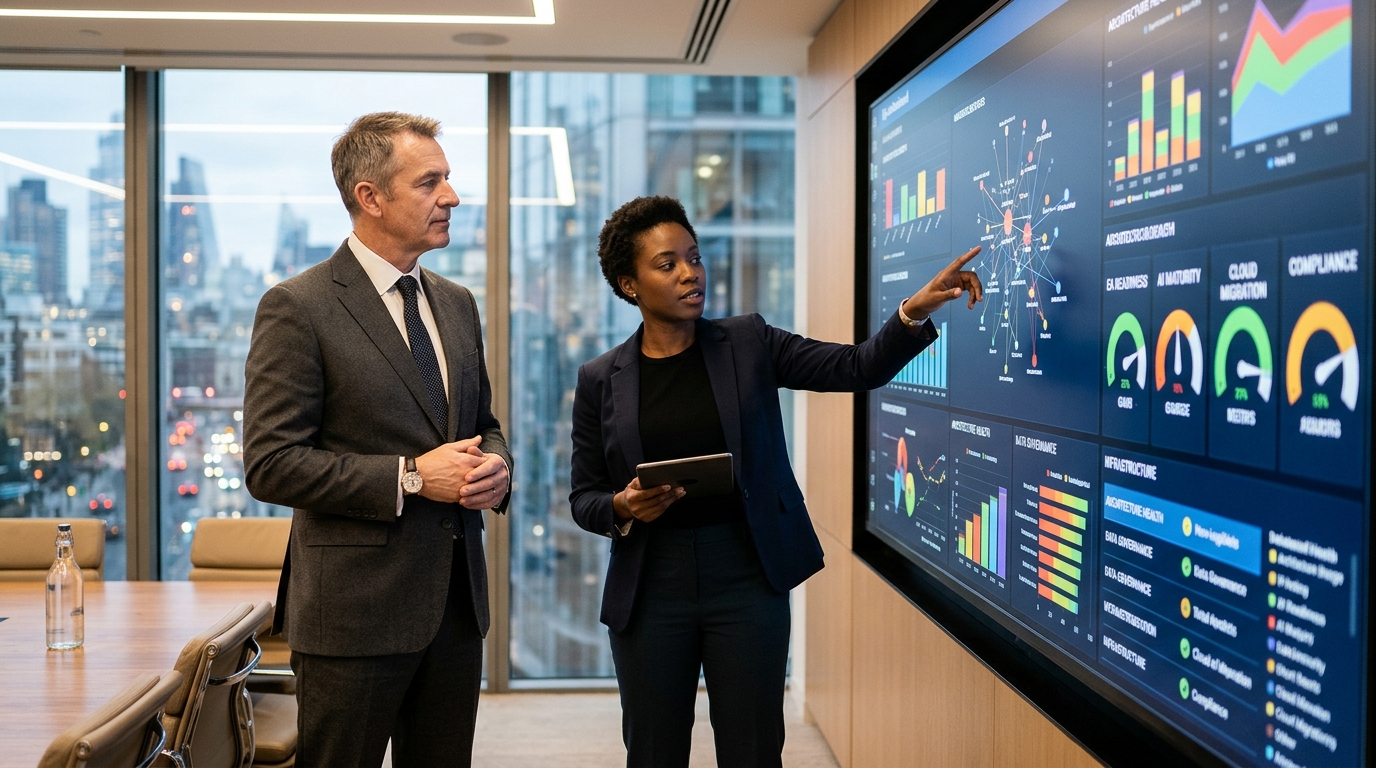
Executive Briefing: The Modernization Imperative
- The Tipping Point: In 2026, enterprise research confirms that "AI-readiness" has officially overtaken infrastructure cost and vendor end-of-life dates as the primary reason organizations migrate off on-premises ERPs.
- The Architectural Wall: Legacy systems (such as Dynamics NAV, AX 2012, AS400, or Sage) are monolithic relational silos. They lack event-driven webhooks, modern REST/OData APIs, semantic definitions, and zero-trust authentication.
- The Deadlock Risk: Forcing generative AI or retrieval agents to query on-premises SQL Server tables directly creates catastrophic lock contention, bringing live shop floor and warehouse operations to a complete standstill.
- Data Fabric as the Bridge: Achieving AI-readiness requires a decoupled data fabric—unifying transactional ERP tables with an enterprise semantic model (Microsoft OneLake / Dataverse) and standardized API tool contracts (Model Context Protocol).
- Strategic Modernization: Migrating to Microsoft Dynamics 365 Business Central Cloud SaaS provides the clean-core foundation necessary to deploy autonomous agents, automated AP processing, and predictive analytics safely.
1. The Paradigm Shift: Why Cost Savings No Longer Drive ERP Modernization
For the past fifteen years, the business case for migrating an on-premises Enterprise Resource Planning (ERP) platform to the cloud followed a predictable script: calculate the Total Cost of Ownership (TCO) of physical server replacements, estimate the labor savings of eliminating manual tape backups, factor in vendor support obsolescence, and present a five-year financial payback schedule.
In 2026, that traditional financial calculation has been eclipsed by an urgent operational reality. Today, the most dangerous cost confronting enterprise leadership is not server hardware depreciation—it is the operational latency of running a blind, disconnected business in an era of autonomous AI execution.
While cloud-native enterprises deploy autonomous agents to match vendor invoices in seconds, dynamically optimize warehouse wave picks, and forecast cash flow in real time, organizations tethered to legacy on-premises ERPs find themselves completely cut off from the modern AI ecosystem.
The bottleneck is rarely a lack of executive ambition or AI investment; it is the fundamental architectural inability of legacy database designs to feed cognitive algorithms. This is the enterprise "AI-Readiness Gap."
2. Architectural Comparison: Legacy On-Premises ERP vs. AI-Ready Cloud Fabric
To understand why AI initiatives stall on legacy platforms, enterprise architects must evaluate how traditional on-premises architectures clash with modern autonomous AI requirements:
| Architectural Dimension | Legacy On-Premises (NAV / AX / Sage) | AI-Ready Cloud Fabric (Dynamics 365 SaaS) |
|---|---|---|
| Data Model & Schema | Proprietary relational tables with cryptic column names (e.g. `Gen_ Prod_ Post_ Grp`), fragmented custom modifications, zero metadata documentation. | Standardized Common Data Model (Dataverse / OneLake) with documented semantic definitions and rich entity metadata. |
| Integration & Eventing | Monolithic nightly batch imports, raw flat-file CSVs, deprecated SOAP endpoints. Zero real-time event webhooks. | Event-driven architecture with native Azure Event Grid webhooks, RESTful OData v4 APIs, and sub-second business event triggers. |
| Security & Authentication | Perimeter VPN, local Windows Active Directory, NTLM/Kerberos. Vulnerable to lateral traversal; cannot enforce modern API tokens. | Microsoft Entra ID Zero Trust, OAuth 2.0 bearer tokens, fine-grained role-based access control (RBAC), conditional access policies. |
| Concurrency & Performance | Heavy table locking during complex SQL queries; background analytical queries directly freeze live production transactions. | Read-scale out replica routing, automated elastic compute, isolated analytical querying via Microsoft Fabric lakehouses. |
| AI Tooling Integration | Requires brittle custom middleware, linked server bridges, or manual data staging tables prone to breaking. | Native Copilot Studio connectors, Model Context Protocol (MCP) server endpoints, and Semantic Kernel enterprise plugins. |
3. The Four Structural Barriers Blocking AI on Legacy ERP Estates
When enterprise teams attempt to bolt generative AI assistants or autonomous bots onto legacy ERP platforms without modernizing their data architecture, they inevitably collide with four technical barriers:
A. The SQL Table Lock Disaster
In legacy architectures like Dynamics NAV C/AL or Dynamics AX 2012, analytical reporting queries and transactional processing share the identical underlying SQL Server database instance. When an AI agent performs deep semantic searches—such as parsing 500,000 historical sales lines to evaluate product substitution suggestions—it issues complex table scans.
In a legacy database engine without read-committed snapshot isolation or read-scale replicas, these queries lock the Sales Line and Item Ledger Entry tables. The immediate result: warehouse barcode scanners freeze, point-of-sale terminals time out, and accounts receivable cannot post cash receipts. The AI initiative is halted to protect core operations.
B. Master Data Fragmentation and the "Garbage In, Hallucination Out" Problem
Over a decade of on-premises operations, ERP databases accumulate immense data debt. Consider a typical legacy master data state:
- Four different vendor records representing the same supplier (`Acme Inc`, `Acme LLC`, `Acme - East`, `ACME INDUSTRIAL`) with conflicting remittance terms and tax identification numbers.
- Free-text item descriptions entered inconsistently by warehouse staff without standardized unit-of-measure hierarchies.
- Orphaned General Ledger accounts with historical postings but no documented dimension tags.
To a human clerk who has worked at the company for fifteen years, these anomalies are navigated through tribal knowledge. But to an autonomous AI agent, this ambiguity is fatal. The agent either hallucinates erroneous three-way match proposals or flags 90% of routine transactions for manual human review, completely defeating the purpose of automation.

C. The Missing "Semantic Layer": Solving the Departmental Margin Conflict
Large language models do not intrinsically understand business logic. They understand language and mathematical symbols. If you ask an AI model, "What was our highest-margin product category in Q3?", the model must understand the exact enterprise definition of "margin."
In a legacy on-premises ERP, "margin" is calculated differently across multiple reports: the sales department calculates margin based on standard cost, finance calculates it after absorbing freight landed costs, and the executive board calculates it after net rebates. Without a centralized, governed semantic layer (such as Dataverse or Microsoft Fabric semantic models), the AI model produces conflicting numbers depending on which table it happens to query.
D. Perimeter-Based Security vs. Zero-Trust API Boundaries
Legacy on-premises systems rely on "castle-and-moat" security: if a user or script is inside the local corporate network or connected via VPN, they have broad access to SQL queries. Conversely, modern autonomous AI agents require fine-grained, tokenized authorization.
Under Microsoft Entra ID and modern REST APIs, every agent invocation is tied to an explicit service principal governed by conditional access policies. If an AI agent attempts to query executive payroll ledgers, the API rejects the request at the perimeter. Legacy systems lack this granular API security boundary entirely, forcing companies to either grant the AI excessive, dangerous permissions or block it altogether.
4. The 4-Layer Architecture for an AI-Ready Enterprise ERP
Overcoming the AI-Readiness Gap requires transitioning from an isolated, monolithic database to a layered enterprise data fabric. Modern architectures decouple intelligence from transactional execution across four distinct layers:
The AI-Ready Enterprise Architecture Stack
- Layer 1: Clean-Core Cloud Transactional Engine: Microsoft Dynamics 365 Business Central Cloud SaaS acts as the single source of operational truth. Core business processes—GL posting, inventory valuation, Order-to-Cash, Procure-to-Pay—run within compiled AL extensions with zero direct SQL modifications, ensuring 100% upgrade safety across semi-annual release waves.
- Layer 2: Real-Time Event Grid & REST/OData API Gateway: Transactions emit business events (e.g., `PurchaseOrderCreated`, `InventoryStockoutRisk`) to Azure Event Grid. Modern API pages (`PageType = API`) expose lightweight, strongly typed JSON endpoints that external applications and AI orchestrators consume without triggering UI overhead.
- Layer 3: Enterprise Semantic Layer & Lakehouse Fabric: Operational data synchronizes near-real-time into Microsoft Fabric / OneLake and Microsoft Dataverse via Azure Synapse Link or Fabric Lakehouse mirroring. Complex analytical queries, cross-table correlations, and historical vector embeddings execute on analytical compute without impacting transactional ERP latency.
- Layer 4: Cognitive Governance & Tooling Layer (MCP & HITL): AI models interact with the ERP exclusively through validated Model Context Protocol (MCP) tool contracts and Power Platform connectors. Deterministic AL business rules enforce accounting validation, while Human-in-the-Loop (HITL) approval queues gate high-dollar financial postings.
5. The 5-Pillar Enterprise AI-Readiness Technical Audit Checklist
Before investing in expensive AI tooling or custom agent development, enterprise IT directors and CFOs should evaluate their existing ERP estate against this 5-pillar technical readiness checklist:
| Audit Pillar | Critical Readiness Criteria | Failure Warning Indicator |
|---|---|---|
| 1. Master Data Hygiene | Deduplicated vendor master, validated tax IDs, structured item descriptions with standardized unit-of-measure attributes. | More than 5% duplicate customer/vendor records; free-text field entries for key financial dimensions. |
| 2. API Modernization | High-speed RESTful OData v4 and custom API pages (`PageType = API`) supporting batch requests and delta sync. | Reliance on legacy SOAP endpoints, direct ODBC linked server queries, or nightly CSV batch flat-files. |
| 3. Event-Driven Telemetry | Asynchronous webhook triggers via Azure Event Grid and Service Bus; live telemetry piped to Azure Application Insights. | No event bus; systems poll SQL tables every 5 minutes to detect state changes, causing lock contention. |
| 4. Identity & Zero Trust | Entra ID managed service principals, OAuth 2.0 bearer tokens, granular role-based access control (RBAC). | Shared administrative SQL credentials (`sa` account) hard-coded into integration connection strings. |
| 5. Semantic Modeling | Centralized definitions of margin, revenue, inventory turn, and backlog stored in Dataverse / Microsoft Fabric. | Disparate departments calculate key operational metrics using divergent Excel formulas. |
6. The Migration Roadmap: From Legacy Debt to AI-Ready Cloud SaaS
Bridging the AI-readiness gap does not require an overwhelming "big bang" overhaul that paralyzes ongoing business operations. A structured, phased cloud modernization roadmap systematically transforms legacy technical debt into an enterprise competitive advantage:
- Phase 1: Code and Data Archival Audit: Catalog legacy C/AL or X++ custom modifications. In most enterprise systems, over 60% of custom modifications built a decade ago are either obsolete or natively supported by Business Central modern feature sets. Archive historical transactional data into cost-effective Azure Blob Storage for tax and compliance requirements rather than inflating cloud operational databases.
- Phase 2: Master Data Normalization & Cleansing: Prior to data ingestion, execute automated deduplication routines across vendor, customer, and inventory records. Standardize payment terms, assign mandatory dimension rules, and establish clean charting hierarchies.
- Phase 3: Clean-Core Implementation on Dynamics 365 Cloud: Deploy Business Central Cloud SaaS using modern AL extensions. Ensure zero code modifications touch base Microsoft tables directly, keeping the tenant 100% compliant with continuous One Version monthly and semi-annual release waves.
- Phase 4: Expose Dataverse and Fabric Semantic Pipelines: Connect Business Central to Microsoft Dataverse via Virtual Tables and mirror operational data to Microsoft Fabric OneLake. This delivers sub-second analytical reporting in Power BI and provides the structured semantic context required by AI models.
- Phase 5: Deploy Governed Autonomous Agents: Activate native Business Central autonomous agents (such as the Payables Agent) and deploy custom Copilot Studio workflows with strict Human-in-the-Loop thresholds, eliminating manual friction while maintaining rigorous audit compliance.
7. Enterprise Modernization Advisory with Allgrow Technologies
At Allgrow Technologies, our practice leads specialize in guiding enterprise organizations through complex cloud modernization and AI data architecture transformations across Microsoft Dynamics 365 Business Central, Finance & Operations, and the Microsoft Power Platform.
As an independent enterprise technology consultancy, Allgrow provides unbiased architectural guidance focused exclusively on your operational longevity and business success:
- AI-Readiness & Architecture Audits: Comprehensive evaluation of database schemas, master data hygiene, API bottlenecks, and security boundaries.
- Clean-Core AL Migration: Upgrading legacy Dynamics NAV and AX customizations into upgrade-safe, cloud-native Business Central extensions.
- Enterprise SLA Protection: 15-minute response times for critical P1 production incidents, proactive telemetry monitoring, and end-to-end data governance.
8. Executive Modernization & AI-Readiness FAQ
Why has "AI-Readiness" replaced cost reduction as the primary driver for ERP modernization?
Historically, ERP migrations were justified primarily through infrastructure cost reductions (eliminating physical server maintenance) or vendor support end-of-life dates. In 2026, enterprise research from leading analyst firms confirms that operational competitiveness hinges on autonomous AI execution—such as automated PO matching, intelligent demand planning, and predictive cash flow. Because legacy on-premises systems lack REST APIs, modern semantic fabrics, and real-time event triggers, they fundamentally cannot support autonomous AI agents, making modernization an existential operational priority.
Can organizations simply connect an LLM or Copilot to their on-premises SQL Server database via ODBC or linked servers?
Technically, one could point a retrieval agent to an on-premises SQL database, but architecturally, it leads to disaster. Legacy databases (such as NAV C/SIDE or AX 2012) lack semantic definitions, rely on obscure abbreviation fields (e.g., "Gen. Prod. Posting Group"), and have no transactional concurrency guards for external AI queries. An AI model generating unindexed read queries directly against production transactional tables frequently triggers severe SQL table deadlocks, crippling everyday warehouse and accounting operations.
What is a "Semantic Layer" and why is it mandatory for ERP AI success?
A semantic layer translates raw relational database tables into standardized, business-friendly terminology with established mathematical logic. For example, if an AI agent is asked "What was our gross margin by customer tier last quarter?", different departments in a legacy system may define margin differently (FIFO vs LIFO, landed freight absorbed vs expensed). A cloud-native semantic model (like Microsoft OneLake or Dataverse) unifies these definitions into a single authoritative source of truth that AI models can query safely and deterministically.
How does legacy data hygiene directly impact autonomous AI agent accuracy?
Autonomous AI agents rely on grounded context to execute decisions. If your legacy master data contains duplicate vendor records with conflicting tax IDs, misspelled item descriptions, or orphaned GL posting groups, the AI agent will either hallucinate erroneous reconciliation proposals or trigger continuous false-positive exception flags. Cleansing, standardizing, and deduplicating master records during migration is non-negotiable for AI-readiness.
What security and identity limitations prevent on-premises ERPs from integrating with modern AI frameworks?
Legacy on-premises ERPs depend on legacy local Active Directory and NTLM/Kerberos network authentication, which cannot enforce modern token-based OAuth 2.0 authorization, conditional access policies, or granular Entra ID role-based access control (RBAC). Modern AI frameworks (such as Anthropic MCP, OpenAI Assistants, and Microsoft Copilot Studio) require zero-trust API authentication to safely evaluate user entitlements before retrieving or staging ERP transactions.
What is the recommended migration path from Dynamics NAV or AX to an AI-ready Dynamics 365 estate?
Rather than attempting a high-risk "lift-and-shift" that copies decades of accumulated custom code and dirty data, enterprises should adopt a clean-core modernization strategy. This involves extracting historical transactional archives into Azure Data Lake/Fabric for compliance reporting, standardizing master data entities, deploying Dynamics 365 Business Central Cloud SaaS using standard AL event subscribers, and establishing modern REST API endpoints for AI orchestration.