

In high-throughput US wholesale, manufacturing, and eCommerce distribution, ERP inventory latency translates directly into lost margin. Major retailers such as Walmart, Target, Home Depot, and Amazon penalize vendors between $5,000 and $50,000 per shipment for missing EDI 856 Advanced Shipping Notices (ASNs) or misformatted UCC-128 carton barcodes. Deploying Dynamics 365 SCM with native Warehouse Management (WMS) and Azure-driven EDI pipelines provides sub-second inventory visibility, eliminates manual shipping reconciliations, and guarantees chargeback-free distribution.
1. The Operational Reality of North American Supply Chains
Mid-market and enterprise organizations operating in North America face an unforgiving fulfillment environment. Operating across multiple regional distribution centers—such as the Inland Empire in Southern California, the Dallas-Fort Worth logistics corridor, and northern New Jersey—requires strict synchronization across warehouse workers, third-party logistics providers (3PLs), and major retail buyer networks.
Legacy ERP platforms like Dynamics AX 2012, Dynamics GP, or disconnected standalone Warehouse Management Systems (WMS) struggle under modern operational requirements:
- Retailer Compliance Chargebacks: Big-box retailers enforce stringent Supplier Operational Standards (SQEP). A single barcode scan failure, inaccurate packing list, or late EDI transmission can wipe out operating margins on entire production runs.
- Inventory Phantom Stock: Batch-synced inventory updates between disconnected eCommerce storefronts, EDI systems, and legacy ERP databases cause dual-allocations, leading to unexpected backorders and cancelled customer orders.
- Rising 3PL Storage & Handling Costs: When ERP systems lack real-time visibility into 3PL warehouse inventory, companies accumulate slow-moving inventory in high-cost metro fulfillment centers while running out of stock in regional hubs.
- Freight Zone Inefficiencies: Fulfilling West Coast customer orders from Midwest facilities due to inaccurate regional stock visibility inflates parcel shipping costs by 30% to 45% through unnecessary cross-country zone shipping.
2. Dynamics 365 SCM & F&O Core Architecture
Microsoft Dynamics 365 Supply Chain Management (SCM), built upon the Finance & Operations enterprise core, provides a unified data model that connects procurement, manufacturing scheduling, quality management, inventory, and automated warehousing into a single transactional ledger.
When architecting an enterprise SCM implementation, three core architectural layers must be established:
- The Transactional Ledger & Inventory Engine: Handles multi-site costing (Standard, FIFO, Moving Average, or Actual Costing), dual-currency accounting, and financial reconciliation. Inventory dimensions are segmented by Site, Warehouse, Location, Inventory Status, License Plate, Batch, and Serial Number.
- The Advanced Warehouse Execution Layer (WMS): Replaces static paper pick lists with mobile RF terminal automation, system-directed putaway, intelligent replenishment, and cluster/wave picking engines.
- The Event-Driven Integration Fabric: Leverages Microsoft Dataverse Dual-Write for real-time synchronization with Dynamics 365 Customer Engagement, and Azure Service Bus combined with Logic Apps for resilient, asynchronous B2B EDI messaging.
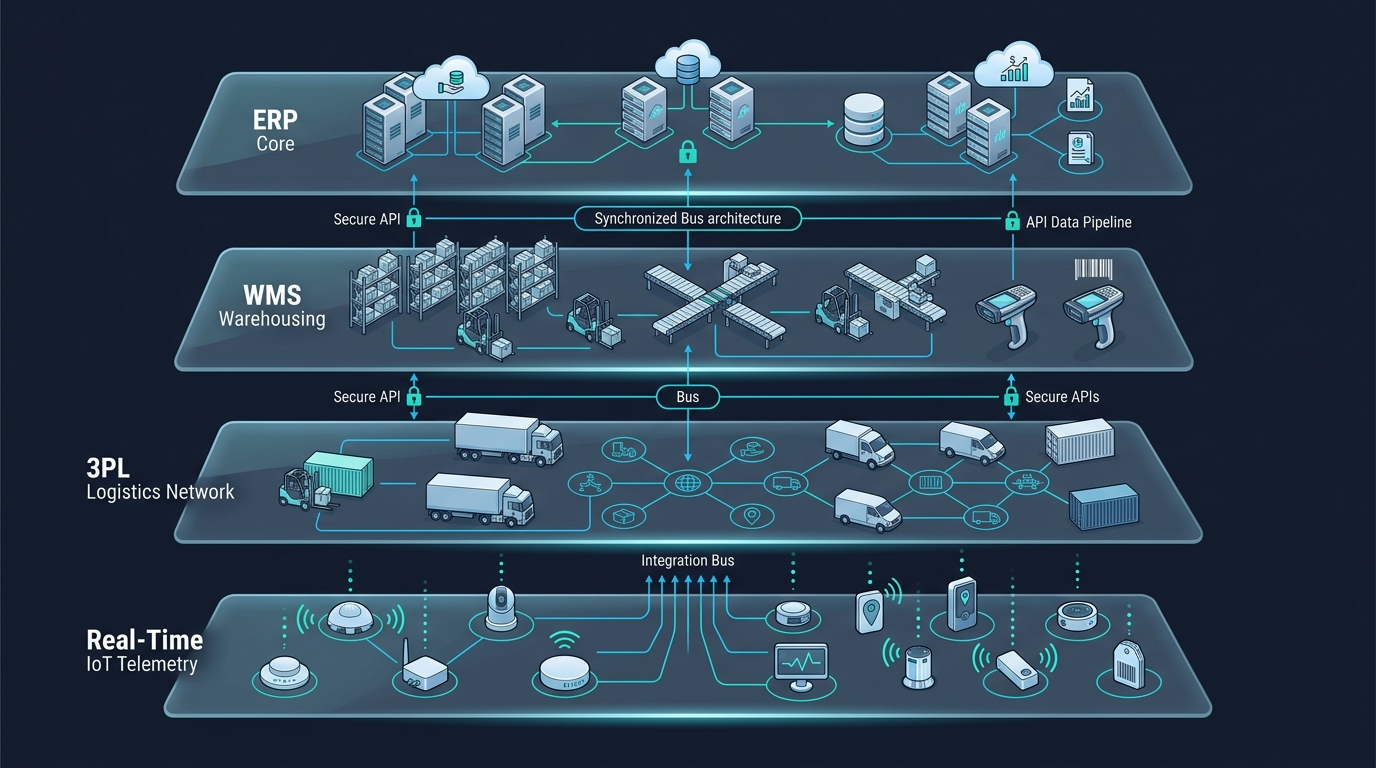
3. Advanced Warehouse Management (WMS): Wave Planning & Mobile Execution
The advanced Warehouse Management module in Dynamics 365 SCM provides enterprise-grade execution without requiring third-party bolt-on software. It enables organizations to manage complex distribution facilities through configurable location directives and work templates.
License Plate Tracking & Parent-Child Pallet Hierarchies
In standard inventory systems, items are tracked only by location (e.g., Aisle 04, Rack 02, Shelf 01). In high-volume operations, tracking items individually creates massive data entry bottlenecks. Dynamics 365 SCM utilizes License Plate (LP) tracking.
A License Plate acts as a unique mobile container tracking unit (analogous to a digital license plate on a vehicle). Warehouse staff scan a single LP barcode on a pallet to move, allocate, or pick dozens of mixed SKUs and thousands of units in a single scan. D365 SCM supports nested parent-child LP structures, enabling full master pallet, inner case, and loose unit tracking across receipt, cross-docking, and container loading.
Wave Planning & System-Directed Putaway
Rather than releasing individual sales orders directly to the floor, D365 SCM groups orders into automated Waves based on customer priority, carrier pickup times (e.g., FedEx Ground 3:00 PM cutoff vs. LTL Freight 5:00 PM pickup), and shipping destination.
- Cluster Picking: A warehouse operator visits pick locations once, picking items into multiple partitioned customer totes simultaneously.
- Zone Picking: Large warehouses divide orders across separate physical zones (e.g., Cold Storage, Secure High-Value, Bulk Racking), consolidating picks at a staging lane prior to packing.
- Directed Putaway: Advanced volumetric algorithms analyze received item dimensions, weight limits, and velocity classifications (Fast/Medium/Slow movers), directing forklift drivers to the mathematically optimal storage location.
UCC-128 & GS1-128 Compliance Labeling
To satisfy North American retail distribution compliance, every outbound pallet and carton must bear a standardized GS1-128 / UCC-128 barcode containing the Serial Shipping Container Code (SSCC-18).
Dynamics 365 SCM generates SSCC-18 identifiers dynamically during the packing and palletization workflows. When the carton or pallet is closed, the system automatically prints the retailer-compliant UCC-128 label directly to Zebra thermal printers via native ZPL integration or cloud printing services, completely eliminating manual labeling desks and post-pack transcription errors.
4. 3PL & Retailer EDI Orchestration: Standardizing Document Pipelines
For US manufacturers and distributors partnering with third-party logistics warehouses (3PLs) or delivering direct-to-retail, Electronic Data Interchange (EDI) is mandatory. Relying on batch CSV file drops or manual portal uploads introduces data synchronization lags that paralyze fulfillment.
An enterprise Dynamics 365 SCM architecture establishes resilient, bidirectional EDI pipelines leveraging standard ANSI ASC X12 document formats:
| EDI Transaction | Direction | Functional Purpose & ERP Impact |
|---|---|---|
| EDI 850 (Purchase Order) | Inbound | Receives customer purchase order from retail partner; automatically validates pricing, credit limits, and generates D365 sales orders without manual touchpoints. |
| EDI 855 (PO Acknowledgment) | Outbound | Confirms order acceptance, delivery schedule, and line-item availability back to the customer within required compliance windows. |
| EDI 940 (Warehouse Shipping Order) | Outbound | Instructs remote 3PL facilities to pick, pack, and stage specific inventory lots and serial numbers for customer shipment. |
| EDI 945 (Warehouse Shipping Advice) | Inbound | Confirms 3PL shipment completion, providing tracking numbers, carrier PRO numbers, lot codes, and exact carton counts to trigger D365 packing slips. |
| EDI 856 (Ship Notice / Manifest - ASN) | Outbound | Transmits exact hierarchical carton-to-pallet packaging details and SSCC barcodes to the retail buyer prior to physical truck arrival at the distribution center. |
| EDI 810 (Commercial Invoice) | Outbound | Transmits final commercial billing details to accounts payable, matching against verified EDI 856 carton receipts for immediate payment processing. |
Architectural Best Practice: Decoupling via Azure Service Bus
Directly calling ERP web services from third-party EDI translation networks is a critical anti-pattern. If Dynamics 365 undergoes scheduled maintenance or rate-limits requests during peak month-end invoicing, incoming EDI 850 or 945 messages can be dropped or rejected.
Our recommended enterprise pattern introduces an Azure Service Bus Queue between the EDI clearinghouse (e.g., SPS Commerce, TrueCommerce, SPS) and Dynamics 365 SCM. Inbound EDI payloads are immediately acknowledged and queued in Azure. Logic Apps or Azure Functions process messages sequentially with automated retry policies and dead-letter queue alerting, guaranteeing zero lost transactions regardless of ERP maintenance windows.
5. Multi-Site Real-Time Inventory Allocation & Zone Fulfillment
Managing multi-facility distribution across diverse geographic regions requires sophisticated allocation logic. In Dynamics 365 SCM, organizations define multi-level inventory hierarchies that distinguish between available physical stock, reserved stock, uninspected quarantine stock, and goods in transit.
Distributed Order Management (DOM) & Smart Fulfillment
Dynamics 365 SCM includes Distributed Order Management (DOM) algorithms that optimize order routing across fulfillment nodes based on business rules:
- Proximity Routing: Automatically routes orders to the warehouse nearest the delivery zip code, minimizing UPS/FedEx shipping zones and cutting transit time from 4 days to 1 day.
- Order Consolidation: Minimizes split shipments by evaluating whether a slightly further facility can fulfill the entire order from a single location, reducing packaging, dunnage, and label costs.
- Inventory Rebalancing & Min/Max Thresholds: Automates transfer orders between central manufacturing hubs and regional 3PL forward-stocking locations before seasonal surges.
6. US Regulatory Compliance, Lot Traceability & Tariffs
For life sciences, chemical distribution, aerospace, and food & beverage manufacturers, supply chain execution is fundamentally tied to strict federal compliance:
- FDA 21 CFR Part 11 & Lot Genealogy: Full backward and forward lot tracing. In the event of a raw material defect, D365 SCM isolates all finished goods pallets containing that specific batch within seconds, preventing shipment and enabling targeted customer recall notices.
- USMCA & Rules of Origin: Automated origin tracking and certified commercial invoice generation for seamless cross-border freight between the US, Canada, and Mexico.
- Section 301 Tariff Accounting: Landed Cost modules in D365 SCM allocate ocean freight, customs brokerage fees, port demurrage, and import duties directly into item inventory valuations, giving finance accurate gross margin reports.
7. Legacy WMS vs. Modern Dynamics 365 SCM Cloud Architecture
| Operational Capability | Legacy ERP / Standalone WMS | Dynamics 365 SCM Cloud Architecture |
|---|---|---|
| Inventory Latency | Batch synced (15–60 min delays); frequent phantom stockouts | Real-time transactional ledger; sub-second cross-channel availability |
| Warehouse Mobility | Proprietary rugged scanners on legacy Windows CE / Telnet | Modern HTML5 / Android native app on modern Zebra, Honeywell, or iOS tablets |
| EDI Integration | Fragile flat-file FTP scripts with manual error monitoring | Event-driven Azure Service Bus with automated retries and dead-lettering |
| Retailer Compliance | Manual post-pack labeling; high risk of SQEP chargebacks | Automated UCC-128 / SSCC barcode generation and electronic EDI 856 ASN parity |
| Landed Cost Tracking | Estimated in spreadsheet journals; variance surprises at fiscal close | Automated allocation of ocean freight, customs, and drayage into item valuation |
8. Implementation Roadmap & US Partner Selection
Migrating to Dynamics 365 Supply Chain Management or modernizing legacy F&O warehouse architecture is a high-impact organizational initiative. Successful cutovers follow a disciplined milestone methodology:
- Facility Discovery & Flow Mapping (Weeks 1–4): Map physical dock-to-stock workflows, aisle layouts, picking zones, UCC-128 label formats, and active EDI trading partner specifications.
- Conference Room Pilot (CRP) & Prototyping (Weeks 5–10): Validate wave picking rules, mobile device menus, and mock EDI message flows against real-world order volumes.
- Integration Hardening & EDI Partner Certification (Weeks 11–16): Complete end-to-end testing with retail partner EDI test portals (e.g., Walmart Retail Link, Amazon Vendor Central, SPS Commerce) to guarantee chargeback-free sign-off.
- Pilot Facility Cutover & Hypercare (Weeks 17–20): Execute cutover over a planned weekend maintenance window. Provide on-site floor support and 24/7 technical monitoring during the initial month-end closing cycle.
Allgrow Technologies architects robust, scalable Microsoft Dynamics 365 Supply Chain Management solutions for US manufacturers, distributors, and logistics leaders. With dedicated practices in ERP modernization, Azure cloud integration, and 24/7 SLA managed support, our senior team ensures seamless retailer compliance, sub-second inventory visibility, and zero-downtime execution.
9. Frequently Asked Questions
Can Dynamics 365 SCM operate alongside Dynamics 365 Business Central?
Yes. Many growing multi-entity organizations utilize a hybrid "two-tier ERP" model where core corporate finance runs on Business Central while high-volume manufacturing or complex automated distribution facilities utilize Dynamics 365 SCM, linked via Dataverse Virtual Tables or Azure Service Bus.
How does D365 SCM prevent retail chargebacks on EDI 856 shipments?
D365 SCM enforces mandatory pallet/carton packaging verification prior to packing slip generation. Outbound ASN data is extracted directly from verified scan records, ensuring 100% data parity between physical carton contents and electronic EDI 856 transmissions.
What hardware is required for the Dynamics 365 Warehouse Mobile App?
The modern Warehouse Management Mobile App runs natively on Android and Windows 10/11 devices, as well as iOS. It supports standard enterprise rugged scanners from Zebra Technologies, Honeywell, and Datalogic, communicating securely over HTTPS without requiring terminal emulation servers.
How long does an enterprise EDI and WMS integration typically take?
A standard implementation connecting Dynamics 365 SCM with 5 to 10 retail EDI trading partners and a modern distribution facility typically spans 16 to 22 weeks from discovery through certified cutover.